


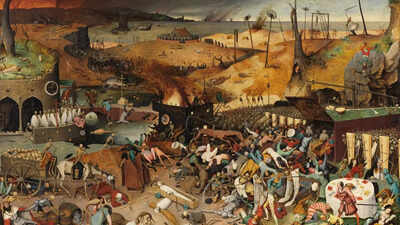
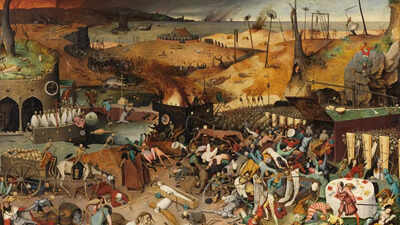
The Black Death, which happened between 1347 and 1352 in Europe, was a catastrophic demographic contraction that caused an enormous change in the demographics of Europe because of its deaths; by killing nearly half of the people living in Europe at that time, the Plague was also a major force that helped to create the cultural ‘Renaissance.’ The Plague destroyed the feudal system, and by destroying this system, the surviving workers (labour force) got higher wages and created a new wealthy class of people (middle class) who had discretionary surplus capital for art and other cultural activities. The Plague also caused a shift in thinking towards humanism because established ecclesiastical institutions did not stop the plague from occurring. As a result, when people began to think differently about life and death, this new way of thinking created a foundation for the economic prosperity and cultural advances that took place during the Renaissance by moving from being concerned about death to being concerned about the human experience. Ultimately, the Renaissance changed the way humanity experienced the despair of death into a time of great creativity and achievement (Golden Age).
What was the Black Death, and how did it built the foundations of the Renaissance in Europe
According to World History Encyclopedia, the Black Death, primarily caused by the bacterium Yersinia pestis, originated in Central Asia and spread to Europe via trade routes in 1347. This bubonic plague pandemic resulted in the deaths of an estimated 75 to 200 million people worldwide. Europe estimated that ‘the great mortality’ killed about half of its population. Following the first impact of a time period of extreme grief and social upheaval, the second long-term effect, a demographic contraction that was essentially a brutal ‘reset button’, transformed several aspects of Europe, including labour, religion, and philosophy.The plague fundamentally destroyed the manorial system, with the working population of Europe drastically reduced. The supply of human labour plummeted, causing its market value to skyrocket. Research at Brown University indicates that this labour shortage gave serfs an opportunity to negotiate for wages and more social freedoms than ever before. This new socio-economic mobility created a new class of wealthy merchants – such as the Medici family – who had the excess capital needed to commission many of the greatest works of art from this period.
How the ‘great mortality’ broke the Church’s monopoly
The people of Europe suffered immense psychological trauma in 14th-century Europe, as the focus of society shifted away from ‘Memento Mori’ (Remember you will die) to a greater emphasis placed upon how to live well before one died. According to the article published on UEN Digital Press with Pressbooks, with medieval medicine and prayer failing to stop the ‘Great Mortality,’ people began questioning religious authority throughout Europe. The erosion of ecclesiastical hegemony (the Church’s total control over thought) left a void, which was then occupied by the Humanist movement, known for promoting reason, logic, and Ancient Greek and Roman wisdom, and serving as the philosophical impetus behind the creation of art and science during the Renaissance.
Why surplus wealth fueled a civic architecture boom
As a result of the death of many people from the plague, there was an enormous loss of people who would inherit their property. This resulted in a large concentration of wealth and property in fewer hands. The World History Encyclopedia suggests that during this period, a significant amount of wealth existed, and this wealth was not just saved. Instead, it was used to fund public buildings and private art. This concentration of wealth created a large amount of capital, which directly led to Florence’s Golden Age. The wealthy used art to improve their cities and show their social status.