



By Anushka Verma
Updated: October 29, 2025
Introduction
For decades, astronomers have gazed in awe at Jupiter — the giant planet whose swirling storms and powerful gravity dominate our solar system. But a groundbreaking new study from Rice University has revealed something even more extraordinary: Jupiter may have been the very reason Earth exists at all.
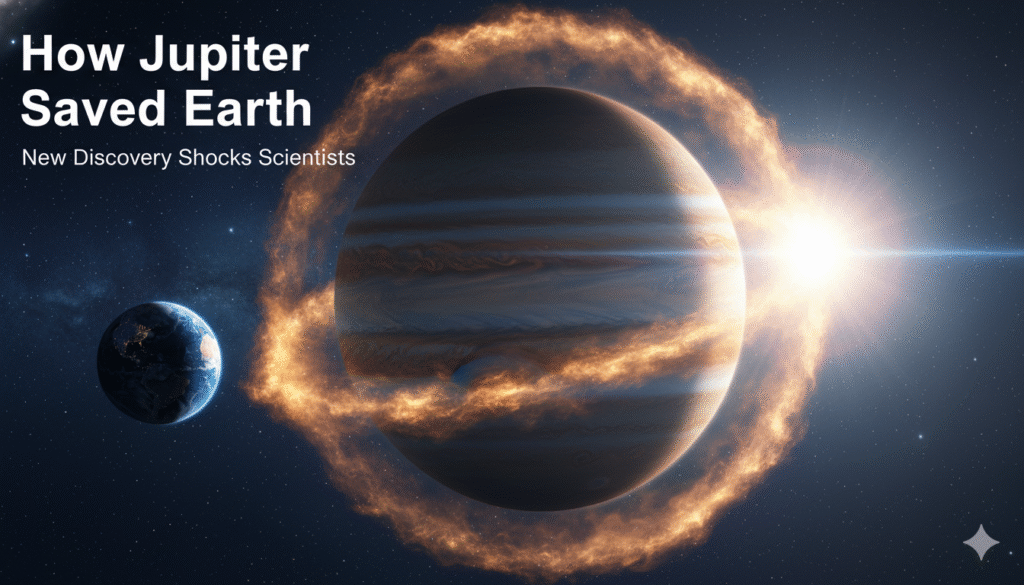
According to scientists, Jupiter’s rapid growth in the early solar system blocked torrents of gas and dust that otherwise would have spiraled toward the Sun, dragging the material that became Earth, Venus, and Mars with it. This cosmic “shield effect” allowed the inner planets to form safely — and ultimately paved the way for life as we know it.
In essence, Jupiter didn’t just become the largest planet in our solar system; it became its guardian, shaping the very architecture that made our world possible.
Quick Overview Table
| Aspect | Details |
|---|---|
| Discovery Institution | Rice University, Department of Earth, Environmental and Planetary Sciences |
| Lead Scientists | Dr. André Izidoro, Assistant Professor; Baibhav Srivastava, Graduate Researcher |
| Published On | October 2025 |
| Main Finding | Jupiter’s early rapid growth blocked gas and dust from reaching the Sun, stabilizing the inner planets. |
| Impact | Explained why Earth and other rocky planets could form without being destroyed by the Sun’s pull. |
| Simulation Used | High-resolution hydrodynamic and isotopic modeling of the early solar disk. |
| Jupiter’s Role | Gravitational barrier, gas flow regulator, solar disk sculptor. |
| Key Result | Jupiter created cosmic “traffic jams” that shaped planetary formation. |
| Mass of Jupiter | 1.9 × 10²⁷ kg (318 times Earth’s mass) |
| Distance from Sun | 778 million km (5.2 AU) |
A Cosmic Guardian in the Early Solar System
Billions of years ago, before Earth even began to form, our solar system was nothing more than a swirling disk of gas and dust encircling a young Sun. In that chaotic environment, materials collided, merged, and disintegrated in a violent process known as accretion.
As the researchers at Rice University discovered, Jupiter grew rapidly during this turbulent period — faster than any other planet. Its immense gravity began to carve gaps in the disk, reshaping the flow of material in ways that would determine the fate of every other world.
Dr. André Izidoro, co-lead author of the study, explained,
“Jupiter didn’t just become the biggest planet — it set the architecture for the entire inner solar system. Without it, we might not have Earth as we know it.”
Jupiter’s mass acted like a cosmic dam, preventing crucial building blocks from being pulled too close to the Sun. This ensured that the inner solar system remained rich enough in rock-forming material for planets like Earth, Venus, and Mars to take shape — but not so unstable that they spiraled inward and disintegrated.
The Science Behind Jupiter’s Early Growth
To unravel Jupiter’s role, researchers created advanced computer simulations mimicking conditions from 4.6 billion years ago. These models tracked the movement of microscopic dust particles, gas flows, and early planetesimals — the first “seed” bodies of future planets.
The simulations revealed a striking pattern: as Jupiter’s mass increased, its gravity generated ripples and resonances throughout the protoplanetary disk. These disturbances acted like “cosmic traffic jams,” slowing the inward drift of materials and carving out distinct regions — an inner and an outer solar system.
Baibhav Srivastava, co-author of the study, noted:
“Our model ties together two things that didn’t fit before — the isotopic fingerprints in meteorites, which come in two types, and the dynamics of how planets formed.”
This finding elegantly explained a long-standing mystery in planetary science: why meteorites — remnants of early solar material — show two distinct isotopic compositions, suggesting that the inner and outer solar systems developed in isolation.
Meteorites Tell the Story of Jupiter’s Barrier
Meteorites are the time capsules of the early solar system. They preserve isotopic signatures that reveal where and when they formed. Some meteorites, known as chondrites, took millions of years longer to form than others.
Scientists have puzzled for decades over why these “latecomers” existed at all. The new Rice University simulations finally provide an answer: Jupiter’s gravitational influence divided the solar system into two zones, blocking the free exchange of material and creating conditions for delayed formation.
“The mystery has always been: why did some meteorites form so late — 2 to 3 million years after the first solids?” Dr. Izidoro explained.
“Our results show that Jupiter itself created the conditions for their delayed birth.”
This “cosmic divide” is now thought to be the key reason our solar system developed its unique two-zone structure, separating gas giants like Jupiter and Saturn from rocky planets like Earth and Mars.

How Jupiter Sculpted the Solar System’s Architecture
The study not only highlights Jupiter’s defensive role but also reveals its creative one. By shaping the disk, Jupiter directly influenced how and where new worlds emerged.
- Carving Gaps and Rings:
As Jupiter grew, it cleared a massive gap in the disk. This prevented large amounts of dust and gas from reaching the Sun and established boundaries that guided the formation of smaller, rocky planets inside its orbit. - Stabilizing Orbits:
Jupiter’s gravity acted like a stabilizing anchor. Without it, inner planets could have drifted into unstable orbits — potentially colliding or being absorbed by the Sun’s gravity. - Defining Planetary Composition:
By dividing the disk, Jupiter determined the chemical makeup of planets. The inner planets, deprived of icy materials, became rocky. The outer planets, rich in frozen gases, became giants. - Protecting Earth Over Time:
Even billions of years later, Jupiter continues to protect Earth. Its immense gravity deflects comets and asteroids that could otherwise impact our planet — earning it the nickname “Earth’s cosmic shield.”
Why This Discovery Matters
This discovery goes beyond the academic realm — it reshapes our understanding of why we exist at all.
Without Jupiter’s early growth and gravitational dominance, the inner solar system might never have stabilized long enough for Earth to form or sustain life.
It also offers a model for studying exoplanetary systems, where gas giants play similar roles. Many distant star systems observed by NASA’s Kepler and James Webb telescopes show signs of massive planets orbiting close to their stars — “hot Jupiters” that likely prevented the formation of habitable worlds.
By understanding our own solar system’s delicate architecture, scientists can now better predict which distant worlds might harbor conditions similar to Earth.
Data Insights: Jupiter’s Role in Solar Stability
| Parameter | Value / Description | Effect on Solar System |
|---|---|---|
| Jupiter’s Mass | 1.9 × 10²⁷ kg | Dominant gravitational body shaping disk flow |
| Orbital Period | 11.86 Earth years | Long-term gravitational resonance stabilizer |
| Formation Time | ~1 million years after Sun’s birth | Rapid growth influenced planetary material flow |
| Distance from Sun | 778 million km | Divided solar system into inner & outer regions |
| Gravity Field Strength | 24.79 m/s² | Deflected comets, reduced asteroid impacts on Earth |
| Magnetic Field | 20,000 times Earth’s | Protected solar system from charged solar wind particles |
| Moons | 95 confirmed | Evidence of strong gravitational capture |
The Cosmic Traffic Jam Explained
The concept of a “cosmic traffic jam” might sound poetic, but it’s a literal description of what Jupiter’s gravity did to the early solar disk.
When gas and dust spiraled toward the Sun, Jupiter’s rapid mass gain caused these flows to pile up, forming dense rings of material. These regions of congestion slowed down the inner migration of matter, creating the perfect cradle for rocky planets to develop.
These “traffic jams” also produced pressure bumps, trapping particles that later became the seeds of meteorites and asteroids — the building blocks of future planets.
Beyond Earth — A Universal Blueprint
The implications extend far beyond our solar system. If Jupiter’s formation created such a profound effect here, similar patterns may occur elsewhere.
Astronomers studying exoplanets now suspect that many solar systems fail to produce habitable planets because their gas giants either form too close to the star or too late. Timing, it seems, is everything.
“Jupiter showed us that not just the presence of a gas giant, but its timing of growth, decides whether rocky planets can survive,” says Srivastava.
“It’s the difference between a system that can host life and one that can’t.”
NASA’s View: A Symphony of Forces
NASA’s Hubble and Juno missions continue to study Jupiter’s structure, atmosphere, and magnetic field, providing new data that supports these theoretical models.
Images captured by Hubble show vibrant auroras and the Great Red Spot, a storm larger than Earth itself, demonstrating the planet’s immense energy dynamics.
NASA scientists emphasize that Jupiter’s role as a stabilizer is ongoing — even today, its gravity continues to shape asteroid belts and protect Earth from many potential cosmic impacts.
The Story of Two Solar Systems
One of the most striking results from the Rice study is the two-family division of meteorites — carbonaceous and non-carbonaceous types.
This distinction suggests that Jupiter effectively split the early solar system into two isolated reservoirs. Materials on either side of its orbit evolved separately, creating vastly different planetary compositions.
In simple terms, Jupiter didn’t just stop matter from falling into the Sun — it created two distinct neighborhoods, each with its own chemistry and destiny.
Future Implications for Planetary Science
The discovery could influence how scientists design future missions to study planet formation. Missions like NASA’s Europa Clipper and ESA’s JUICE (JUpiter ICy moons Explorer) are already heading toward Jupiter’s system to explore its moons and magnetosphere.
Understanding how Jupiter once shaped the entire solar system will help researchers decode the origins of life-supporting conditions across the cosmos.
It also reinforces a broader truth: the story of Earth cannot be told without Jupiter.
Conclusion: The Planet That Made Us Possible
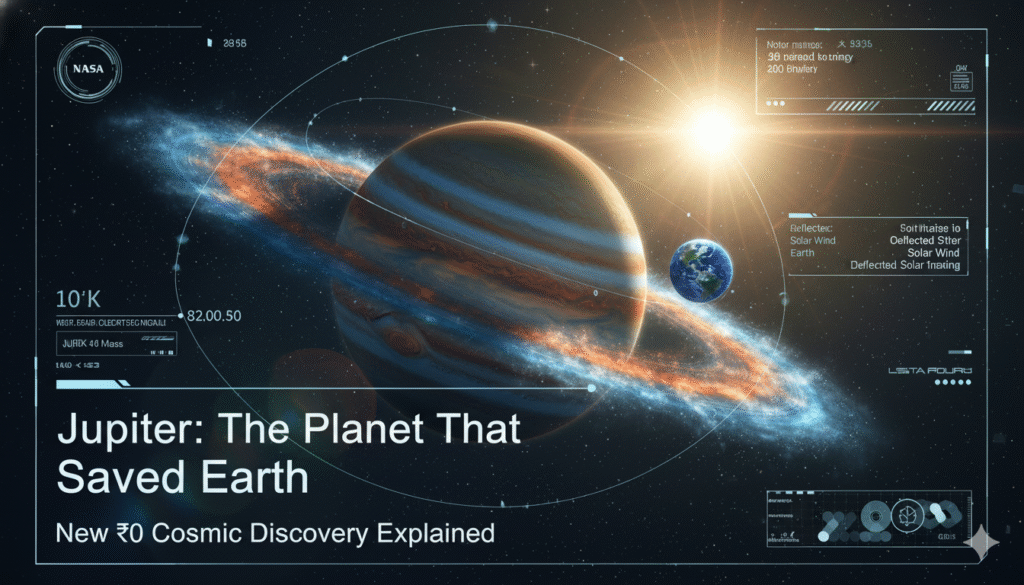
When we look at Jupiter in the night sky — bright, distant, and majestic — we see more than just a planet. We see our cosmic protector, the unseen architect of our world.
From shielding early Earth to shaping the path of every inner planet, Jupiter’s influence reaches across billions of years.
Its gravity was not merely a force; it was a creator, a guardian, and a designer of destiny.
Without Jupiter’s early might, Earth might never have formed, oceans might never have flowed, and humanity might never have looked up at the stars in wonder.
And that, perhaps, is the most astonishing discovery of all — a ₹0 cosmic miracle that changed everything.


