



By: Anushka Verma |October 29, 2025
Subheadline
NASA’s Europa Clipper spacecraft, on its journey to study Jupiter’s icy moon, may soon experience an extraordinary encounter — crossing the ion tail of an interstellar comet named 3I/ATLAS. This once-in-a-lifetime alignment could allow humanity its first indirect taste of matter from another star system.
Table: Europa Clipper & 3I/ATLAS – Key Mission Data
| Parameter | Details |
|---|---|
| Mission Name | Europa Clipper |
| Agency | NASA |
| Mission Cost | $5 Billion |
| Launch Date | October 12, 2024 |
| Current Status | En route to Jupiter; post-Mars flyby |
| Potential Event | Crossing the ion tail of comet 3I/ATLAS |
| Comet Origin | Interstellar (outside our solar system) |
| Predicted Date Range of Encounter | October 30 – November 6, 2025 |
| Key Scientists Involved | Samuel Grant (FMI), Geraint Jones (ESA) |
| Prediction Model Used | Tailcatcher |
| Significance | First-ever detection of interstellar ions by a spacecraft |
| Other Spacecraft Nearby | ESA’s Hera (without ion detectors) |
Introduction: A Rare Cosmic Coincidence
In the vast emptiness of space, where distances between celestial bodies stretch across billions of kilometers, coincidences are rare. Yet, this month, a remarkable cosmic alignment might occur — one that has scientists around the world buzzing with anticipation.
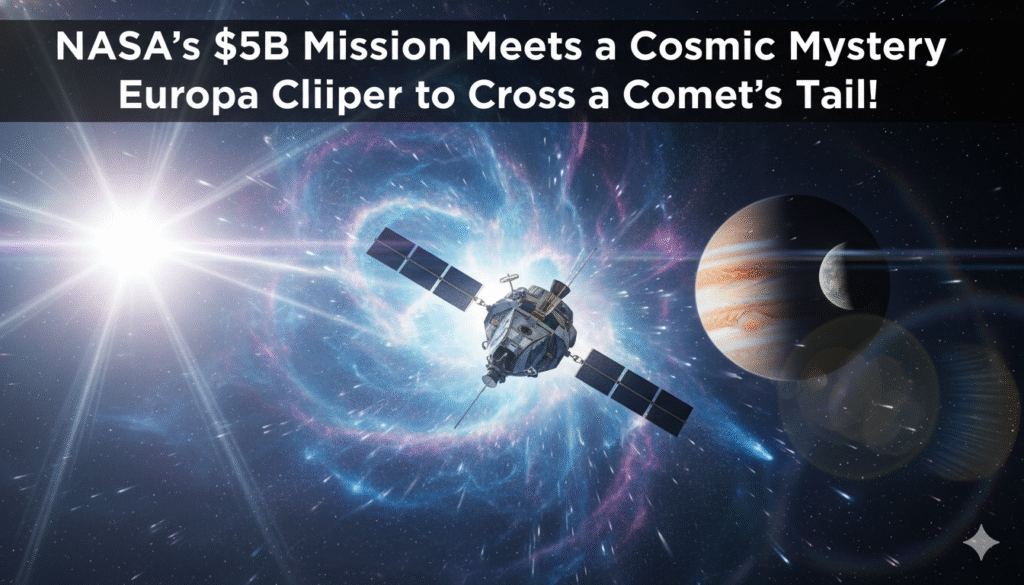
NASA’s Europa Clipper spacecraft, built to explore Jupiter’s icy moon Europa in search of potential signs of life, could soon intersect the ion tail of an interstellar comet — 3I/ATLAS.
This event, predicted to happen between October 30 and November 6, 2025, might allow the spacecraft to sample particles from another star system — without ever leaving the solar system itself.
“It’s the closest we can currently get to directly sampling another part of the galaxy,” said Samuel Grant, a space plasma physicist at the Finnish Meteorological Institute (FMI), who co-authored the prediction model with Geraint Jones of the European Space Agency (ESA).
Europa Clipper: NASA’s $5 Billion Journey of Discovery
The Europa Clipper mission, launched in October 2024, is one of NASA’s most ambitious projects in recent decades. With an estimated cost of $5 billion, it represents a monumental effort to understand whether Europa — one of Jupiter’s 95 known moons — could harbor conditions suitable for life.
Equipped with a suite of high-precision instruments, including spectrometers, plasma detectors, and imaging systems, the spacecraft is designed to orbit Jupiter and make dozens of close flybys of Europa. Its goal: to study the moon’s subsurface ocean, icy crust, and atmospheric composition.
But before reaching Jupiter in 2030, the spacecraft is traversing the inner solar system — and this path has unexpectedly placed it near the projected path of comet 3I/ATLAS’s ion tail.
What Makes 3I/ATLAS Special
Comet 3I/ATLAS (officially the third interstellar object ever detected after ‘Oumuamua and 2I/Borisov) is unlike most comets we’ve seen before. Unlike those born in our solar system, 3I/ATLAS comes from a distant star system — possibly dozens or even hundreds of light-years away.
The comet was discovered in April 2025 by the Asteroid Terrestrial-impact Last Alert System (ATLAS) in Hawaii. Its path, as calculated by astronomers, showed a hyperbolic trajectory — confirming it was not bound by the Sun’s gravity.
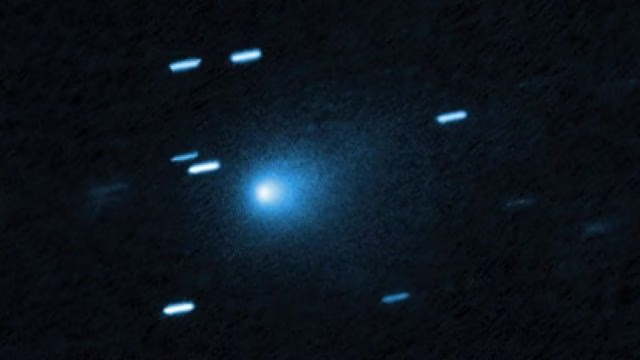
By July 2025, NASA’s Hubble Space Telescope captured a striking image of the comet, revealing a glowing teardrop-shaped dust cloud emanating from its solid icy nucleus. At that time, the comet was about 277 million miles (445 million km) from Earth.
As it nears the Sun, 3I/ATLAS heats up, releasing gas and dust — forming both a dust tail (made of fine grains) and an ion tail (made of charged particles). It is this ion tail that Europa Clipper might encounter.
The Tailcatcher Model: Predicting a Galactic Intersection
Grant and Jones used a sophisticated computer model called Tailcatcher, which simulates the behavior of solar wind — the continuous stream of charged particles emitted by the Sun — as it interacts with a comet’s ionized gases.
Here’s how it works:
- As the solar wind passes the comet, it strips ions from the comet’s coma (the glowing cloud surrounding it).
- These ions are then carried away along the solar wind stream, forming the ion tail, which always points away from the Sun.
- Depending on the speed and direction of the solar wind, this tail can stretch millions of kilometers into space — far enough to potentially intersect with spacecraft located within that region.
Using Tailcatcher, the duo found that Europa Clipper, which is currently 300 million kilometers from the Sun, could cross a region where these cometary ions are being carried.
Why This Matters: Sampling Another Star System
To scientists, this event represents far more than a chance encounter — it’s a potential window into another solar system’s chemistry.
Every comet holds primitive material from the time of its formation. In the case of interstellar comets, that material comes from another star system, meaning it could contain different isotopes, molecules, and minerals than those formed around our Sun.
“We have virtually no data on the interior of interstellar comets or the star systems that formed them,” explained Grant. “Sampling their ions — even indirectly — can help us understand what kind of environments exist around other stars.”
If Europa Clipper’s instruments detect these ions, scientists could measure:
- Elemental composition (e.g., hydrogen, oxygen, carbon, nitrogen ratios)
- Presence of heavier molecules such as water-group ions (H₂O⁺, OH⁺)
- Differences in isotopic ratios, revealing the age and conditions of the comet’s birth cloud
These findings could expand our understanding of how planetary systems evolve across the galaxy.
How the Detection Would Work
Europa Clipper’s instruments were not designed to study comets — yet they’re perfectly capable of detecting charged particles.
One of its key instruments, the Plasma Instrument for Magnetic Sounding (PIMS), is meant to study Jupiter’s magnetic environment and Europa’s induced magnetic field. However, it can also measure ion densities, energies, and charge-to-mass ratios — all crucial for identifying cometary ions.
If the spacecraft indeed passes through a stream of interstellar ions, scientists expect:
- A noticeable shift in particle composition from normal solar wind (mostly protons and helium nuclei) to heavier ions.
- A temporary slowing and deflection of the solar wind, caused by the added mass from cometary material.
- Energy signatures consistent with water-group ions.
This combination would confirm Europa Clipper’s brush with an interstellar visitor.
Safety First: No Risk to the Spacecraft
Although the idea of a spacecraft “crossing a comet tail” might sound dangerous, experts assure it’s perfectly safe. The ion tail is extremely diffuse — far thinner than the best laboratory vacuum on Earth.
“It’s like driving through a faint cosmic mist,” said Geraint Jones, an ESA space plasma physicist. “The particles are so few and far between that there’s no physical hazard to the spacecraft.”
Instead, the real challenge lies in detecting the faint signal amidst background solar wind noise — a scientific, not operational, hurdle.
ESA’s Hera: A Missed Opportunity
Interestingly, the European Space Agency’s Hera spacecraft, currently en route to study the Didymos–Dimorphos asteroid system, will also cross a similar region of space during this period (between October 25 and November 1).
However, Hera lacks the instruments capable of detecting ions, meaning only Europa Clipper has the tools to measure this unique interaction.
That makes Clipper’s potential crossing even more valuable — a one-time experiment that cannot be replicated until the next interstellar comet passes through our neighborhood, which could take decades or even centuries.
Past Success: Tailcatcher’s Proven Accuracy
This isn’t the first time the Tailcatcher model has made such a prediction.
In 2020, it successfully forecast when ESA’s Solar Orbiter would detect ions from comet C/2019 Y4 (ATLAS) — a purely solar-system comet.
The detection confirmed the model’s accuracy, giving scientists confidence that the Europa Clipper–3I/ATLAS alignment could indeed occur as predicted.
The Broader Implications: Understanding Cosmic Chemistry
If Europa Clipper detects interstellar ions, it could redefine how we study extrasolar material. Until now, scientists have relied on:
- Telescopic observations (limited to light and spectral analysis)
- Meteorite studies (restricted to solar-system samples)
- Interstellar dust collection (via missions like Stardust)
But this event would be the first time a spacecraft within our solar system detects charged particles from another star’s debris.
Such measurements could answer key questions:
- Are interstellar comets chemically similar to our own?
- Do they contain the same building blocks for life — like amino acid precursors or complex organics?
- Could the ingredients for life be universal across the galaxy?
Challenges Ahead
There are still several uncertainties that could affect whether Europa Clipper actually crosses the ion tail:
- Solar Wind Variability:
The direction and speed of solar wind can change drastically within hours. A strong solar storm could deflect the ion tail away from the spacecraft. - Comet Activity Level:
3I/ATLAS’s peak activity is expected around October 29, but if its outgassing rate is lower than predicted, the ion tail might not extend far enough. - Instrument Availability:
NASA’s Europa Clipper team must decide whether to schedule specific observation windows for this event. Since Grant and Jones are not part of the Clipper mission, the initiative rests with NASA scientists.
Looking Forward: Comet Interceptor Mission
Even if Europa Clipper misses this encounter, the lessons from this prediction will prove invaluable for future missions.
ESA’s upcoming Comet Interceptor, launching in 2029, is designed specifically to fly through the coma and tail of a fresh or interstellar comet.
It will carry instruments capable of sampling dust, gas, and ions directly — fulfilling what Europa Clipper may only glimpse.
“The science community is gradually building the tools needed to explore interstellar material directly,” said Jones. “This is just the beginning.”
A Step Toward Galactic Exploration
In many ways, this potential encounter between Europa Clipper and 3I/ATLAS symbolizes humanity’s growing reach.
Just decades ago, the idea of detecting — let alone sampling — matter from another star system was pure science fiction.
Now, thanks to precise modeling and a bit of cosmic luck, it may happen accidentally — by a spacecraft already on a mission to search for life beyond Earth.
Whether or not the encounter materializes, it underscores an important truth:
Every spacecraft, every mission, carries the potential to reveal something we never expected — something that brings us a step closer to understanding our place in the cosmos.
Conclusion
The Europa Clipper’s potential crossing of 3I/ATLAS’s ion tail is more than an astronomical curiosity — it’s a scientific milestone in interstellar research.
For the first time, we may be able to study matter born in another star system, carried by the solar wind across billions of kilometers, and captured by human technology.
It’s a testament to both human ingenuity and cosmic coincidence — a reminder that even in the silent, endless reaches of space, the universe occasionally aligns to let us peek beyond our own star’s boundaries.

