



By Anushka Verma | November 18, 2025
Introduction
In an era defined by rapid advancements in artificial intelligence, nothing has captured the global imagination quite like the rise of large language models (LLMs). These models, powered by trillions of parameters, have fundamentally changed the way humans interact with machines. They write essays, generate code, engage in conversations, and analyze vast amounts of textual data. Yet even as LLMs dominate the AI landscape, a new paradigm is emerging—one that promises to move beyond text and venture into the fabric of physical reality.
This new frontier is known as Physical AI, and leading this transformation is an ambitious, secretive, and incredibly well-funded initiative called Project Prometheus. Backed and co-led by Jeff Bezos, and armed with a staggering $6.2 billion in capital, the project is already being described as one of the most daring scientific and technological endeavors of the decade.
Physical AI represents a dramatic shift in how intelligence is conceptualized. While traditional LLMs learn from textual data, world models—the backbone of Physical AI—learn from sensory data. They observe movement, physics, spatial relationships, mechanical interactions, and real-world cause-and-effect. For many scientists, world models represent the next evolutionary leap toward creating true artificial general intelligence.
Project Prometheus aims to accelerate breakthroughs in:
- robotics
- drug design
- material science
- aerospace engineering
- manufacturing
- medical discovery
- scientific experimentation
This 4000-word article will explore the origins, ambitions, scientific significance, and global implications of Project Prometheus. It will analyze the motivations behind Jeff Bezos’ sudden return to operational leadership, the role of co-CEO Vik Bajaj, the competitive landscape, and the growing belief among experts that LLMs—despite their power—are a technological dead-end when it comes to real-world reasoning.
As the world confronts unprecedented global challenges and opportunities, Project Prometheus stands at the threshold of creating the next generation of intelligence—one that may leave even today’s most advanced AI systems looking primitive.
The Return of Jeff Bezos: Why Now?
Jeff Bezos stepped down as CEO of Amazon in 2021, announcing his intention to focus on personal initiatives and Blue Origin, his aerospace company. For several years, he made occasional public appearances but remained largely removed from day-to-day technological developments.
But behind the scenes, Bezos was watching something transformative unfold.
The sudden acceleration of AI—especially post-2023—served as a wake-up call for many industry veterans. Systems began to demonstrate reasoning, coding abilities, visual recognition, and problem-solving skills once thought impossible. And while LLMs were impressive, they had limitations that became increasingly clear to people with deep scientific and technical backgrounds.
Bezos understood that the next frontier would not be chatbots. It would be AI capable of interacting with the real world, reshaping industries in ways the digital revolution never could.
Four Reasons Bezos Returned
- AI Is the Defining Technology of the Next Century
Bezos has long believed in supporting technologies that shape humanity’s future—e-commerce, cloud computing, space exploration, and now physical AI. - Robotics Will Become a Trillion-Dollar Sector
With Amazon having invested heavily in warehouse automation, Bezos was among the first major CEOs to see the massive potential of robotics paired with intelligence. - Physical AI Could Revolutionize Blue Origin
Smarter materials, more efficient propulsion systems, and advanced engineering simulations are all areas where world models can accelerate aerospace innovation. - A Unique Chance to Lead a New Scientific Era
LLMs are dominated by existing giants (OpenAI, Google, Meta). Bezos saw a rare window to lead humanity’s next technological revolution—one built on scientific discovery rather than text modeling.
For someone who once described Amazon as a “Day One company,” Project Prometheus represents Day One for an entirely new kind of intelligence.
What Exactly Is Project Prometheus?
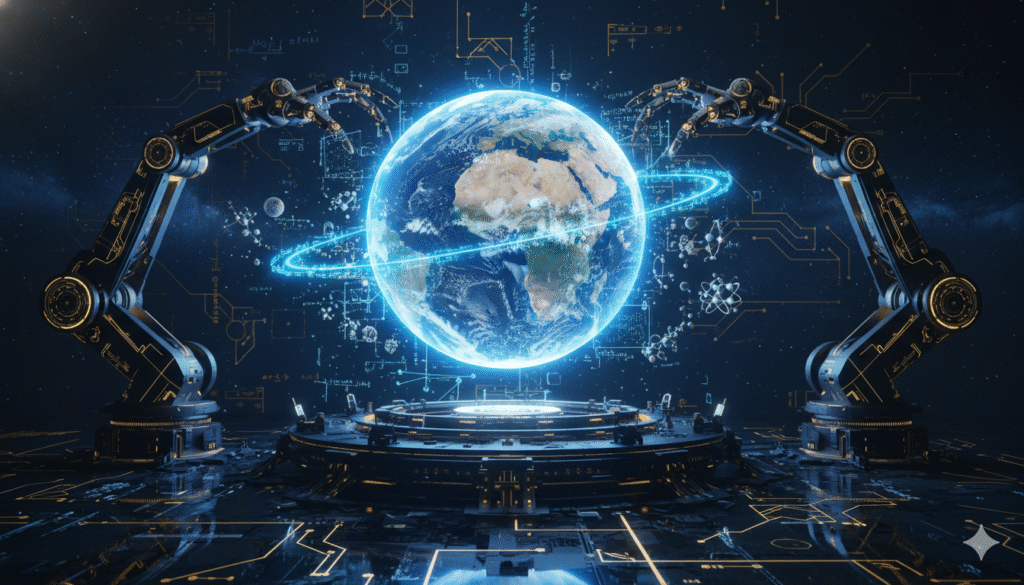
At its core, Project Prometheus is an advanced research company focused on building world models—AI systems that understand physics, chemistry, motion, and the underlying rules of the real world.
The name, inspired by the Greek Titan Prometheus, symbolizes the giving of “fire”—in this case, the fire of intelligence—to humanity. Unlike traditional labs, Prometheus is not attached to a university or corporate ecosystem. It is a private, independent entity with near-limitless resources and the freedom to explore bold, unconventional projects.
Key Characteristics
- Funding: $6.2 billion at inception
- Team: ~100 top researchers from OpenAI, DeepMind, Meta, and leading universities
- Leadership: Jeff Bezos & Vik Bajaj
- Goal: Accelerate scientific and physical discovery through AI
- Approach: Build AI that learns from physics-based data, sensory input, simulation, and real-world experimentation
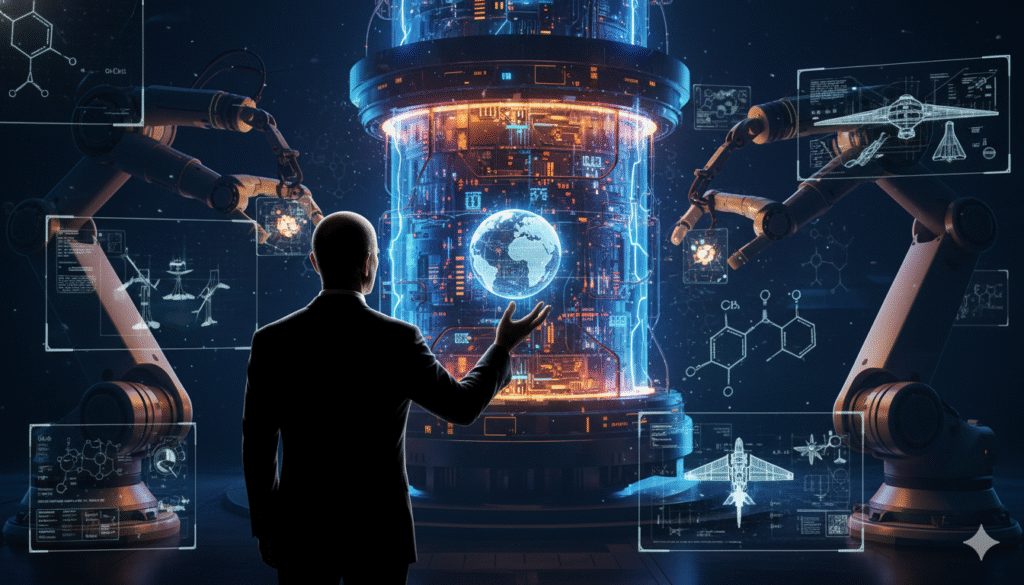
The vision is not to replace human researchers but to empower them by giving them tools capable of simulating, testing, and optimizing at superhuman speed.
Why Physical AI Matters More Than Ever
Most AI systems today learn from the internet—books, articles, code, posts, videos, and human-generated content. While powerful, these systems lack grounding in the physical world.
They cannot:
- manipulate objects
- understand three-dimensional space
- simulate chemical reactions
- design machines based on physics
- conduct experiments
- plan mechanical actions
- reason over real-world causes and effects
This is the gap Physical AI aims to fill.
The Physical World Is Where True Value Lies
Almost every major global industry depends not on text, but on physical reality:
- manufacturing
- energy
- medicine
- transportation
- agriculture
- chemistry
- construction
- aerospace
If AI can master physical reasoning, it can transform all of these sectors in ways LLMs cannot.
The Scientific Bottleneck
Today, breakthroughs in science depend on:
- slow manual experimentation
- limited lab capacity
- human trial-and-error
- expensive physical prototypes
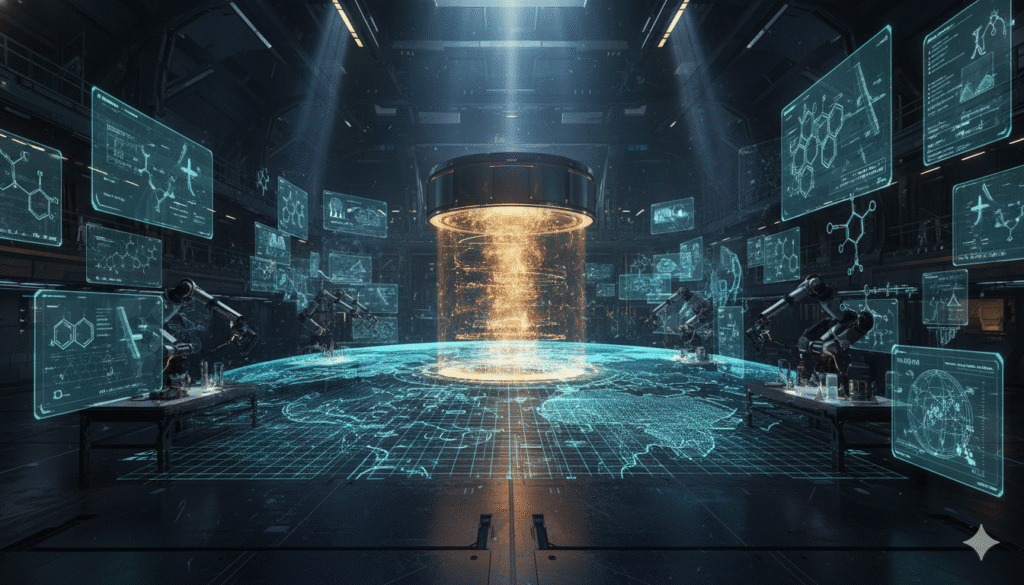
AI agents that can conduct millions of experiments in simulation—and then perform real-world tests with robotic precision—could compress decades of scientific progress into years.
Project Prometheus wants to become the engine speeding up human discovery.
Prometheus and the Rise of World Models
World models are AI systems that:
- perceive sensory inputs
- understand physical dynamics
- build internal simulations
- predict outcomes of actions
- reason about space, motion, and cause-and-effect
Unlike LLMs, which “think” in text, world models “think” in physics.
How World Models Work
They learn from:
- videos of real-world motion
- robot interactions
- physics engines
- 3D environments
- chemical and molecular simulations
- scientific datasets
- mechanical systems
The result is a model that has an internal representation of the environment. It can predict:
- what happens if you rotate an object
- how a material bends under pressure
- how molecules react in solution
- how a drone flies through turbulent air
- how a machine part will fail under stress
Human babies learn through this kind of sensory modeling. Prometheus aims to replicate this process at machine scale.
The Leadership Team: Jeff Bezos and Vik Bajaj
Jeff Bezos: Vision + Capital + Long-Term Thinking
Bezos brings:
- strategic insight
- financial resources
- operational expertise
- moonshot thinking
- access to global partnerships
He understands both business and breakthrough innovation, making him uniquely suited to lead a project of this magnitude.
Vik Bajaj: Scientific Intelligence and Research Excellence
Vik Bajaj, the co-CEO, is one of the most respected scientific minds in Silicon Valley. His background includes:
- working with Sergey Brin at Google X
- developing advanced computational biology frameworks
- leading deep research teams
- experience across engineering, physics, and biomedical science
Bajaj represents the research soul of Prometheus. Bezos represents the strategic engine. Together, they aim to create an unprecedented scientific institution.
The Talent War: Why Top Researchers Defected to Prometheus
Prometheus has hired talent from:
- OpenAI
- Google DeepMind
- Meta FAIR
- Apple ML
- Stanford
- MIT
- Caltech
These researchers left behind:
- huge salaries
- comfortable positions
- prestigious labs
Why?
Because Prometheus offers something rare: the freedom to invent the future without corporate constraints.
Reasons Talent Joined Prometheus
- access to billions in compute
- full research autonomy
- no product deadlines
- focus on fundamental science
- the chance to build the next major AI paradigm
- a culture centered on exploration and discovery
For many, this is as close as one can get to a modern-day Manhattan Project or Apollo Program.
The Limitations of LLMs: Why They Can’t Achieve Physical Intelligence
LLMs are powerful, but they are fundamentally limited.
They can:
- predict words
- write text
- process knowledge
- reason symbolically
- generate summaries
But they cannot:
- understand 3D space
- simulate physics
- perform controlled experiments
- manipulate mechanical systems
- perceive real-world motion
Yann LeCun, a leading AI scientist, famously said LLMs are “a dead end” when it comes to achieving human-level reasoning.
He argues that intelligence is rooted in sensory understanding. Humans learn by interacting with the world. Machines must do the same.
Prometheus adopts this philosophy.
Prometheus vs Competitors: A New Tech Race
Prometheus is not alone. Several startups are attempting to build Physical AI:
Periodic Labs
Works on robotic scientific experimentation.
Physical Intelligence
Builds sensory-driven AI systems.
Covariant
Focuses on industrial robotics.
Sanctuary AI and Figure AI
Work on humanoid robots with cognitive abilities.
Tesla Optimus
A robotics program led by Elon Musk.
But Prometheus has three unparalleled advantages:
- $6.2 billion in early funding
- Jeff Bezos’ leadership
- A concentration of elite talent
This combination positions Prometheus as the most formidable force in the world-model revolution.
Potential Impact on Global Industries
Physical AI isn’t just another technological upgrade. It is a foundational shift that can transform the world.
1. Robots That Can Learn Like Humans
Factories could become fully automated—not with programmed robots, but with intelligent agents that understand:
- fluid movement
- object manipulation
- spatial reasoning
2. Accelerated Drug Discovery
Prometheus AI can model molecules, test interactions, and simulate reactions far faster than human scientists.
3. Materials Engineering Revolution
Imagine discovering:
- ultra-light metals
- heat-resistant ceramics
- new superconductors
World models can test millions of combinations virtually.
4. Aerospace Innovation
AI can design:
- propulsion systems
- next-generation rockets
- drones with adaptive intelligence
- safer spacecraft materials
Blue Origin will benefit indirectly.
5. Energy & Climate Breakthroughs
Physical AI can optimize:
- battery chemistry
- solar panel design
- carbon capture systems
6. Manufacturing Efficiency
Factories could evolve into fully autonomous, self-improving systems.
Ethical and Security Challenges
Building superhuman Physical AI raises serious questions:
- Who controls the technology?
- How do we prevent misuse?
- Will automation eliminate millions of jobs?
- Could AI design dangerous biological agents?
- How do we regulate rapidly accelerating discovery?
Bezos and Bajaj have acknowledged the risks but believe innovation cannot be halted. Instead, it must be guided responsibly.
The Future of Project Prometheus
Prometheus is still early in its journey, but early indicators suggest:
- rapid breakthroughs
- aggressive hiring
- heavy investment in robotics
- substantial advances in simulation
- global interest from governments and scientists
Many experts believe Prometheus could become:
- the OpenAI of world models
- the DeepMind of physical reasoning
- the Tesla of robotics
- the Bell Labs of the 21st century
Conclusion
Project Prometheus represents a monumental shift in the evolution of artificial intelligence. With $6.2 billion in backing, a world-class team of researchers, and the combined leadership of Jeff Bezos and Vik Bajaj, the initiative stands poised to change the course of science, industry, and global innovation.
If LLMs transformed the digital world, Physical AI promises to transform the physical one.
The implications are profound:
- scientific revolutions accelerated
- robotics elevated to new heights
- engineering redesigned
- medicine reinvented
- industries disrupted
As humanity enters a new age of discovery, Project Prometheus may become the most influential AI initiative since the birth of machine learning. What begins today as a secretive, massively funded startup could soon redefine what intelligence means—and how far it can go.