


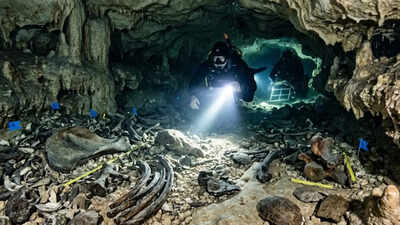
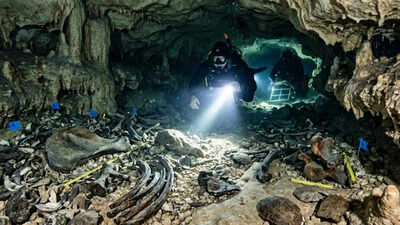
A remarkable find in an active underground stream has recently been made deep beneath the rolling hills of the Edwards Plateau. During a snorkelling excursion through the low ceilings and dark passages of Bender’s Cave in Comal County, Texas, researchers discovered an enormous ‘lag assemblage’ of Pleistocene megafauna. It is also uniquely important, as it contains fossils from previously undocumented species in the region (giant tortoises and lion-sized pampatheres (Holmesina septentrionalis). These finds are forcing palaeontologists to rethink their beliefs about the ancient climate of Central Texas, as the data gest that there was a much warmer and more humid climate during a time that was previously thought to be dominated by cool, dry grasslands.
Discovery of rare fossils in Texas’s Bender’s Cave
A collection of large animal fossils from an active streambed location has provided the basis for this work. According to research published in Cambridge University Press, bones from the largest animals that lived during the Ice Age, mammoths, mastodons, sabre-toothed cats and giant ground sloths were identified. The fossils were mineralised and had a calcite coating from prolonged exposure to carbonate – saturated underground water; this mineralisation and coating had preserved the fossils in a ‘lag assemblage’ on the cave floor.
From lion-sized Armadillos to giant tortoises: Rare finds on the Edwards Plateau
As noted in the findings of Jackson School of Geosciences and The University of Texas at Austin, the most notable scientific finds were bones from a giant tortoise (Hesperotestudo) and a pampathere (Holmesina septentrionalis). The pampatheres, which were about the size of a lion, are a close relative of the modern armadillo, but both of these species have never been found on the Edwards Plateau before. Their presence represents an extreme anomaly because both species require a warm, humid, frost-free climate, which is an attribute that differs significantly from the cool, moist models accepted for the Late Pleistocene in the Edwards Plateau.
How cluster analysis revealed a 100,000-year-old warm climate
The University of Texas researchers faced challenges in ascertaining the precise dating of the bones; the first initial radiocarbon analysis of the bioapatite indicated an age of about 17,000 years however this is determined to be an inaccurate date because of carbonate contamination within the cave environment; Thus through the use of cluster analysis it was determined that based upon fossils found at different points within a water cave in texas, that the fossils are actually from the warm climate during marine isotope stage 5 which is more than 100,000 years before now.
How researchers navigated submerged cave passages
The investigation of the water cave system represents one of the first formal investigations of water-filled cave systems within the state of Texas. As compared to the majority of excavation sites located within dry cave systems, the researchers were required to employ snorkel gear/wetsuits with additional underwater lighting to help provide them with better visibility through the lower ceilings of the stream bed/cave passages. By using this type of technology and methodology, the scientists were able to conduct sampling of 21 different zones along the stream bed. Additionally, the results from this investigation indicate that underwater cave systems represent an excellent location for preserving paleobiological records from the past.