



By: Anushka Verma | Updated: October 29, 2025
Abstract
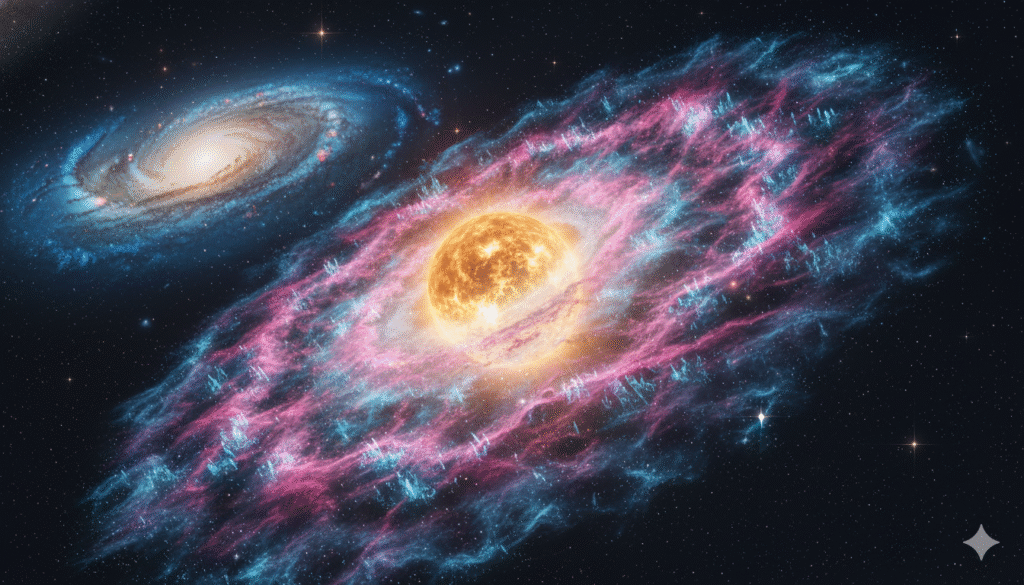
In a stunning leap for cosmic chemistry, astronomers using the James Webb Space Telescope (JWST) have discovered multiple complex organic molecules frozen in ice around a young star, ST6, in the Large Magellanic Cloud (LMC) — a dwarf galaxy orbiting about 160,000 light-years from Earth.
This marks the first detection of such intricate prebiotic compounds outside the Milky Way, revealing that the chemical ingredients for life can assemble even in primitive, metal-poor galaxies. The finding opens a new chapter in humanity’s search for the origins of life.
Table: Key Facts About the Discovery
| Aspect | Details |
|---|---|
| Telescope Used | James Webb Space Telescope (JWST) |
| Discovery Site | Large Magellanic Cloud (LMC) |
| Distance from Earth | 160,000 light-years |
| Object Name | ST6 (young protostar) |
| Detected Compounds | Five carbon-rich organic molecules |
| Medium of Detection | Ice-coated interstellar dust grains |
| Environment Type | Metal-poor, early-universe-like region |
| Scientific Impact | Shows complex chemistry can form beyond the Milky Way |
| Collaborating Institutes | International Institute for Cosmic Origins & partners |
| Date of Announcement | October 2025 |
A Glimpse into the Universe’s Earliest Chemistry
Across the darkness of interstellar space, stars ignite inside thick clouds of gas and dust — the same cosmic nurseries that forged the raw materials of life.
By capturing infrared light invisible to the human eye, the JWST has peered through those dusty cocoons and uncovered something extraordinary: frozen molecules containing carbon, oxygen, and hydrogen — the core elements of organic life.
Around the infant star ST6 in the LMC, the telescope’s instruments revealed molecular fingerprints identical to compounds found in Earth-based prebiotic experiments. These include methanol (CH₃OH), formaldehyde (H₂CO), and acetaldehyde (CH₃CHO) — chemicals that can combine into amino acids and sugars under the right conditions.
This discovery provides a direct window into chemistry that may mirror what once unfolded in our own solar system billions of years ago.
The Power of the James Webb Space Telescope
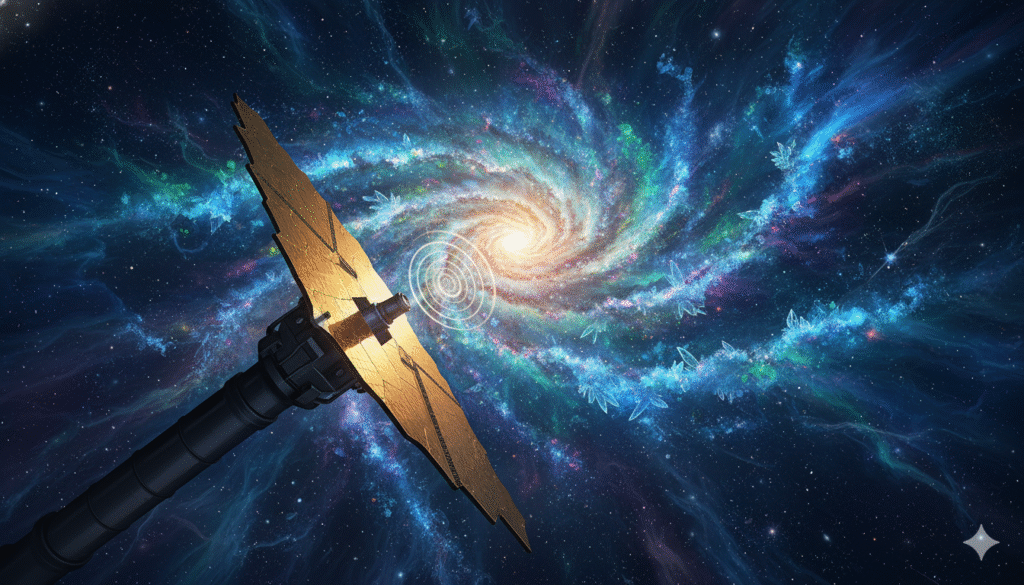
The JWST’s sensitivity to infrared wavelengths makes it the only observatory capable of identifying frozen molecules within distant star-forming clouds.
For this study, astronomers used both the Mid-Infrared Instrument (MIRI) and Near-Infrared Spectrograph (NIRSpec) to measure light absorbed and emitted by the icy material around ST6.
The Large Magellanic Cloud was deliberately chosen because of its low abundance of heavy elements — similar to conditions that existed when the universe was just a few hundred million years old. Detecting complex chemistry there demonstrates that life-friendly molecules can form even when the cosmos is short on metals such as carbon, nitrogen, and oxygen.
As lead chemist Dr. Rhea Lindström explained,
“What Webb has shown us is breathtaking. Even in the universe’s poorer neighborhoods, nature finds ways to assemble complexity. The chemistry of life is not an Earth-only story — it’s a cosmic one.”
Dust Grains: The Universe’s Hidden Laboratories
Every molecule identified by the JWST owes its existence to microscopic dust grains.
These particles — made of silicates, carbon, and ice — drift between the stars and act as natural catalysts. At temperatures close to absolute zero, single atoms land on their surfaces and bond to form new compounds. Over time, these reactions layer complex ices that preserve molecular fossils of creation.
When nearby stars emit ultraviolet radiation, those ices undergo further transformation, producing alcohols, aldehydes, and other carbon-rich molecules. Eventually, as newborn stars heat their surroundings, the ice evaporates, releasing organics into space where they can seed new solar systems.
Finding this same chemistry around ST6 in the LMC implies that the recipe for life’s building blocks is universal, written into dust and light since the earliest epochs of cosmic time.
Life’s Ingredients Beyond the Milky Way
The implication of this discovery is vast:
If such chemistry exists in a galaxy with barely one-tenth the Milky Way’s metallicity, then the early universe may have been chemically richer than anyone imagined.
This supports the idea that life’s raw ingredients predate the Milky Way itself, spreading through interstellar space via comets, asteroids, and cosmic dust — a process known as panspermia.
While panspermia remains unproven, the JWST’s detection gives it a scientific backbone: the molecules required for life are abundant, ancient, and resilient.
Astrobiologist Dr. Kei Morimoto notes,
“If carbon chemistry is happening everywhere, then the universe could be teeming not just with stars but with potential.”
Reconstructing the Early Universe
Because the Large Magellanic Cloud resembles galaxies that existed more than ten billion years ago, studying ST6 is like peering into the universe’s childhood.
The complex organics now observed could mirror what formed long before Earth appeared — suggesting that prebiotic chemistry is a fundamental outcome of galaxy evolution.
In addition to ST6, the research team plans to survey other protostars within and beyond our galaxy to determine whether similar molecules appear elsewhere. Mapping those chemical fingerprints could reveal a timeline for the emergence of life-supporting compounds across cosmic history.
The Scientific Method Behind the Discovery
To confirm their findings, astronomers compared JWST spectra with laboratory data from ice samples cooled to near-space temperatures.
Each molecule absorbs infrared light at unique frequencies, producing identifiable dips — a molecular signature. The five carbon-rich compounds detected around ST6 matched those laboratory patterns with remarkable precision.
Researchers then modeled the physical conditions of the surrounding dust cloud — estimating temperatures between 10 and 30 kelvin and densities dense enough for ices to form but cold enough to prevent evaporation. Such environments are fertile grounds for organic synthesis.
Challenges and Limitations
Despite the triumph, scientists remain cautious. The observed molecules, though complex, are not biological; they are precursors — the first steps on a long chemical road toward life.
To confirm whether these compounds can evolve into amino acids or nucleobases, astronomers will need higher-resolution data and future missions capable of directly sampling interstellar ice.
Moreover, because the LMC lies outside the Milky Way, its faintness poses challenges in verifying isotopic ratios — subtle variations that reveal how and when molecules formed.
Still, even with these uncertainties, the detection stands as one of the JWST’s most compelling achievements to date.
Why This Matters for Humanity
Discoveries like this are not merely scientific footnotes — they redefine humanity’s place in the cosmos.
For centuries, people have wondered whether the chemistry of life is a singular miracle or a natural outcome of universal laws.
By revealing that the same molecules exist light-years beyond our galaxy, the JWST provides a humbling, exhilarating answer: life’s chemistry is everywhere.
This insight fuels future missions, inspires new generations of scientists, and deepens the philosophical question of whether we are alone.
If organic matter is common, then perhaps the spark that turned molecules into microbes — and microbes into minds — is not unique to Earth.
The Road Ahead
Following this landmark discovery, the research team plans to expand its survey to other regions within the LMC and its companion galaxy, the Small Magellanic Cloud.
By comparing chemical abundances, astronomers hope to trace how molecular complexity grows with metallicity and stellar evolution.
Future instruments like the Origins Space Telescope and Extremely Large Telescope (ELT) will allow even deeper observations, potentially identifying amino acid precursors or biologically relevant molecules in other galaxies.
The ultimate goal is to build a chemical map of the universe — showing where, when, and how the seeds of life appear.
Expert Reactions Across the Scientific Community
Since the announcement, the global astronomy community has erupted with enthusiasm.
Professor Leah Patterson of the University of Cambridge called the finding “a Rosetta Stone for cosmic chemistry,” while NASA’s Astrophysics Director, Dr. James Wilkins, described it as “proof that the universe is not barren but biologically fertile at its roots.”
Even outside science circles, philosophers and theologians are engaging with the implications. The notion that organic complexity is intrinsic to the universe blurs the line between physics and life, matter and meaning.
Public Engagement and Education
Within days of publication, the story dominated science headlines worldwide. JWST’s breathtaking imagery of the LMC region, combined with the poetic notion of frozen life ingredients drifting through space, has captured public imagination.
Educational institutions are incorporating the finding into astronomy curricula, emphasizing how infrared spectroscopy reveals unseen aspects of creation.
For young students, the message is both scientific and inspirational: understanding the cosmos begins with curiosity — the same spark that drives chemistry in the coldest corners of space.
Economic and Technological Value — The “Price” of Discovery
Though priceless in scientific worth, the discovery carries a measurable “price tag” in technology and collaboration.
The JWST itself cost approximately $10 billion, representing two decades of engineering and international partnership among NASA, ESA, and CSA. Each observation campaign, including the ST6 study, involves thousands of hours of data analysis and computing time across multiple continents.
Yet, as Anushka Verma notes in this report, the true price of discovery lies not in dollars but in human curiosity — our relentless drive to look deeper, ask harder questions, and connect the smallest molecule to the grandest cosmic narrative.
Conclusion: Life Written in Starlight
The detection of complex organic ices around ST6 in the Large Magellanic Cloud is more than an astronomical milestone; it is a philosophical awakening.
It tells us that the chemistry of life is not confined to Earth, not even to our galaxy, but is woven into the very fabric of the cosmos.
Every dust grain that glimmers in the darkness carries the potential for creation.
Every molecule frozen in a distant cloud whispers the same ancient message: we are part of a universal story — one still being written in starlight.


