



By Anushka Verma | Updated: October 29, 2025
Introduction: The Sky Is Not Empty Anymore
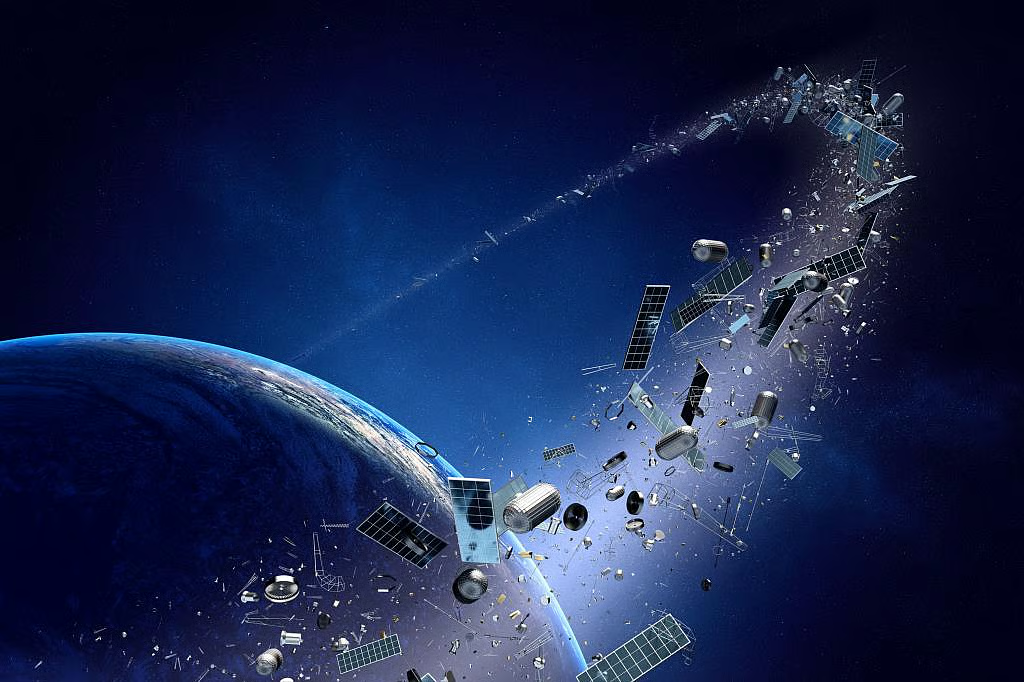
Look up at the night sky — it appears vast, silent, and endless. But behind that serene view lies chaos. Earth’s orbit, once a pristine expanse for exploration, has turned into a congested junkyard. Thousands of defunct satellites, rocket fragments, and metallic shards now circle our planet at staggering speeds of 28,000 km/h, posing catastrophic threats to the very systems we depend on daily — communication, navigation, weather forecasting, and even national security.
Experts estimate that cleaning this orbital mess could cost over ₹500 crore per large-scale cleanup mission, and the price of inaction might be even higher — total loss of access to safe orbital paths for decades.
The story of how Earth’s orbit became a landfill is not one of negligence alone, but of ambition, competition, and a global commons left unguarded.
Table: Key Facts About Space Junk in 2025
| Category | Details (2025 Estimates) |
|---|---|
| Total Trackable Debris (>10 cm) | 36,000+ pieces |
| Small Debris (1 mm – 10 cm) | Over 130 million fragments |
| Average Orbital Speed | 28,000 km/h |
| Oldest Debris Still in Orbit | Vanguard 1 (launched 1958) |
| Countries Responsible for Most Debris | USA, Russia, China |
| Estimated Cleanup Cost | ₹500–₹1,000 crore per mission |
| Most Dangerous Orbit Zone | 700–1,000 km (Low Earth Orbit) |
| Recent Major Debris Events | China ASAT test (2007), India Mission Shakti (2019) |
The Birth of Orbital Pollution: From Glory to Garbage
The journey began in 1957, when the Soviet Union launched Sputnik-1, the world’s first artificial satellite. It was a moment of triumph for humanity — proof that space was within reach. But with that triumph came a hidden cost: every launch left behind booster stages, nuts, bolts, and fuel tanks that remained adrift.
During the Cold War, the space race intensified. The United States and the Soviet Union launched thousands of satellites and missiles, each adding fragments to orbit. Recovery or cleanup was never a concern — prestige came first, sustainability never entered the discussion.
As one NASA engineer famously said,
“Space was never meant to be a landfill, but that’s what we’ve turned it into.”
Today, nearly 70% of all orbital debris can be traced back to early superpower missions. Later contributions came from Europe, Japan, China, and India — as commercial and scientific ambitions grew, so did the junk cloud encircling Earth.
A Commons No One Owns — And Everyone Pollutes
Space, like the oceans or the atmosphere, is a global commons — shared by all, owned by none. Every nation uses it for satellites, weather monitoring, and defense, but few take responsibility for keeping it clean.
When a rocket breaks apart or an old satellite explodes, the fragments don’t disappear. They keep orbiting, crossing paths with active satellites, increasing the risk of collisions. The worst part? Even a piece the size of a coin can destroy a billion-rupee satellite.
In 2024, a chilling example reminded us of how real this threat is. A two-pound metallic shard — part of a broken ISS module — crashed through a home in Florida, tearing through the roof and narrowly missing a child. That wasn’t science fiction. It was orbital trash returning home.
The Two Events That Changed Everything
1. The 2007 Chinese Anti-Satellite Test
In January 2007, China destroyed its weather satellite FY-1C using an anti-satellite (ASAT) missile. The explosion created over 2,300 trackable pieces of debris — each moving at 28,000 km/h. Many of those fragments remain in orbit today, still posing collision risks to working satellites.
2. India’s Mission Shakti (2019)
On March 27, 2019, India conducted its first ASAT test under Mission Shakti, destroying the Microsat-R satellite. While officials said the debris would fall quickly, tracking data revealed that hundreds of fragments lingered, some rising above the altitude of the International Space Station. It was a reminder that even controlled missions can leave behind long-term hazards.
These two events, separated by a decade, sparked global debate and forced agencies to confront an uncomfortable truth — every act of destruction in orbit multiplies danger for everyone.
The Kessler Syndrome: A Nightmare in Motion
In 1978, NASA scientist Donald Kessler proposed a grim scenario now known as the Kessler Syndrome — a chain reaction where one collision generates debris, which triggers more collisions, creating an unstoppable cascade.
If this chain reaction begins in earnest, certain orbital zones could become unusable for centuries. The result?
- Loss of GPS navigation.
- Disrupted internet connectivity.
- Failed satellite communications.
- Impaired weather monitoring.
- Crippled global trade and defense operations.
A single debris cloud could paralyze modern civilization’s most vital infrastructure.
Why Cleaning Space Is So Difficult
Cleaning space isn’t like picking up plastic bottles. It’s like catching bullets in motion — millions of them, all invisible to the naked eye.
1. Tracking Challenges
Many debris pieces are too small to detect, but large enough to destroy. Ground-based radars can only track objects larger than 10 cm.
2. Speed and Altitude
At 28,000 km/h, even a flake of paint can puncture spacecraft. The higher the altitude, the longer debris stays in orbit — sometimes for hundreds of years.
3. Cost and Risk
Every cleanup mission requires a robotic spacecraft to rendezvous, capture, and de-orbit the junk — costing hundreds of crores with no direct profit.
4. Legal and Political Issues
Who owns space junk? Who’s responsible for cleanup? A Russian satellite fragment hitting an Indian satellite could spark diplomatic disputes. There are no clear international compensation laws for debris damage.

Engineering Solutions: The Race to Clean the Sky
Space agencies and private companies are experimenting with futuristic methods to tackle orbital debris:
- Robotic Sweepers: Autonomous spacecraft that latch onto debris and push it toward Earth’s atmosphere for safe disintegration.
- Drag Sails: Devices that increase air resistance to accelerate orbital decay.
- Laser Brooms: Ground-based lasers that nudge small debris into lower orbits.
- Electrodynamic Tethers: Long conductive cables that generate drag using Earth’s magnetic field.
- AI Tracking Systems: Machine learning models predicting potential collisions days in advance.
Japan’s JAXA and India’s ISRO are working on laser-based debris management systems, aiming for the first operational test by 2027.
The Economics of Neglect
If left unchecked, space debris could lead to annual global losses worth ₹20,000 crore or more — through damaged satellites, disrupted services, and lost launches.
- Satellite replacement cost: ₹800–₹1,200 crore each.
- Insurance losses: ₹5,000+ crore per decade.
- Communication disruptions: Priceless — affecting billions.
And yet, there’s no global cleanup fund. No market incentivizes nations to pay upfront for prevention. Economists call this a “commons failure” — shared risk, neglected responsibility.
The Human Cost: When Space Trash Falls to Earth
Every year, about 100–200 small debris pieces re-enter Earth’s atmosphere. Most burn up harmlessly, but not all. Some fragments survive the descent and crash unpredictably.
The Florida incident (2024) was the first verified case of orbital debris damaging private property in the US. As satellite constellations like Starlink, OneWeb, and Amazon’s Kuiper expand, the odds of re-entry collisions will only rise.
The irony? Humanity’s technological progress is literally falling back to Earth — as trash.
Policy and Prevention: A Global Tug of War
Despite growing awareness, space law still lags behind reality. The Outer Space Treaty (1967) forbids claiming ownership of space, but says little about garbage management.
Some promising frameworks include:
- 25-Year Deorbit Rule: Satellites must re-enter or move to graveyard orbit within 25 years of mission end.
- Liability Conventions: Assign partial responsibility to launching states.
- Data Sharing: Joint tracking databases to improve collision forecasts.
However, compliance is voluntary, and enforcement is weak. Nations prioritize sovereignty and commercial growth over collective safety.
India’s Role: A Responsible Space Power
India has emerged as a major space player with missions like Chandrayaan-3, Aditya-L1, and the Gaganyaan program. ISRO, learning from past experiences, has incorporated post-mission disposal plans for all new satellites.
Additionally, India is:
- Developing laser-based debris tracking systems.
- Partnering with Japan (JAXA) on orbital cleaning projects.
- Advocating for international cooperation frameworks through the UN.
India’s balanced stance — technological advancement with sustainability — may set a model for other emerging space nations.
The Private Sector Steps In
Companies like ClearSpace (Switzerland), Astroscale (Japan), and OrbitGuard (India) are entering the cleanup market. Their goal: make orbital sustainability profitable.
For example:
- ClearSpace-1 (ESA Mission, 2026): Will capture and de-orbit a Vega rocket part.
- Astroscale ELSA-d (Japan): Demonstrated magnetic docking with debris.
- OrbitGuard (India, 2025): Aims to develop low-cost tether-based cleanup tech using indigenous components.
The dream is to turn orbital cleanup into a global business — where space sustainability becomes both a necessity and an opportunity.
A ₹500 Crore Question: Who Pays for the Cleanup?
Here lies the dilemma. The benefit of a clean orbit is shared by all, but the cost is borne by few. No single nation wants to foot the bill. Yet, without investment, future generations might lose access to orbit entirely.
Experts suggest:
- Global Debris Tax: Collected from every satellite launch.
- Shared Cleanup Fund: Managed by the UN or a consortium.
- “Polluter Pays” Principle: Nations responsible for the most debris bear the highest cleanup cost.
Until such mechanisms are agreed upon, the junk will only multiply.
The Future: Responsibility as the New Frontier
The next great space race won’t be about who goes farther — it’ll be about who takes responsibility for what’s already been done.
If left unchecked, our launchpads may soon resemble landfills, not gateways. But if humanity learns from its mistakes, the same innovation that created this problem could also solve it.
Astrophysicist Mallika Sarabhai once said,
“When you launch a satellite, you also launch a lifelong theatre of fragments.”
It’s time that theatre had a curtain call.
Conclusion: Our Orbit, Our Responsibility
Earth’s orbit is the beating heart of modern civilization. Every call, transaction, flight, and forecast depends on it. And yet, we’ve treated it as disposable.
Cleaning it won’t be easy or cheap — each mission could cost ₹500 crore or more. But the cost of neglect would be far greater: the loss of safe access to space, perhaps forever.
As nations, corporations, and citizens, we must ask a simple question:
If we can reach the stars, can we not clean our own backyard first?

