



Written by Anushka Verma
Published: December 10, 2025
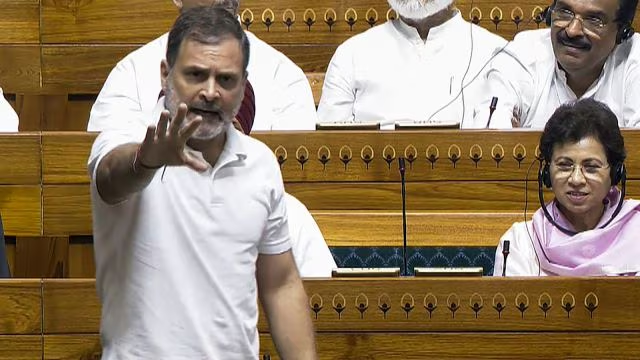
In a fiery and consequential speech in the Lok Sabha that has sent shockwaves through India’s political landscape, Leader of the Opposition Rahul Gandhi issued a stark warning to the ruling establishment: the Congress party, upon returning to power, will retrospectively change laws to hold accountable those it accuses of undermining democracy. The core of his incendiary charge was that the Election Commission of India (ECI), along with other pivotal institutions, has been “captured” by the Rashtriya Swayamsevak Sangh (RSS) and the Bharatiya Janata Party (BJP), orchestrating what he termed the “biggest anti-national act”—the theft of the people’s vote.
The setting was a discussion on electoral reforms, but Gandhi transformed it into a direct indictment of the Modi government’s decade-long tenure. “We will change the law retrospectively, and we will come looking for you,” Gandhi declared, his words hanging in a charged parliamentary atmosphere. This promise of retrospective legal action—a tool often criticized for creating legal uncertainty but framed here as an instrument of democratic justice—marked an unprecedented escalation in the political war over India’s institutional integrity.
A Trio of Damning Questions: Unpacking the “Capture” of the ECI
Gandhi structured his argument around three pointed questions designed to allege a systematic takeover of the election watchdog. First, he challenged the controversial 2023 legislative change that removed the Chief Justice of India from the panel selecting election commissioners, placing the power solely in the hands of the Prime Minister, the Leader of the Opposition, and a Union Minister nominated by the PM. “I am there, but I have no voice in the room,” Gandhi stated, portraying the LoP’s presence as a mere formality in a process dominated by the executive.
His second question targeted the Election Commissioners (Conditions of Service) Amendment Act, 2023, which grants immunity to election commissioners for acts done in the course of their duty. “No government had done so in the past,” Gandhi emphasized, framing this legal shield not as protection for impartiality, but as a license for misconduct with impunity.
The third pillar of his attack focused on a procedural change with profound implications for electoral transparency. He highlighted a rule instituted on May 30, 2025, which allows for the destruction of CCTV footage from strong rooms and polling stations after 45 days of result declaration. “Why was it allowed for the EC to destroy the footage?” he asked. In an era where digital evidence is paramount, this reduction in the preservation period, according to Gandhi, erases the forensic trail needed to investigate electoral malpractice, making the ECI’s operations dangerously opaque.
The Blueprint for Reform vs. The Reality of “Tailored” Campaigns
Contrasting this alleged opacity, Gandhi presented a “very simple” four-point charter for genuine electoral reform:
- Providing the complete voters’ list to all political parties one month before elections.
- Preserving CCTV footage indefinitely to ensure an auditable trail.
- Granting technical experts from political parties access to examine the architecture and software of Electronic Voting Machines (EVMs).
- Ending the legal immunity for the Election Commission.
He juxtaposed this clarity of demand with what he described as a corrupted reality. Gandhi alleged that the ECI was “colluding with those in power to shape the elections,” tailoring the election schedule and campaign periods to suit Prime Minister Narendra Modi’s requirements. He cited alleged instances of massive electoral roll manipulation, claiming a Brazilian national appeared 22 times and one woman 200 times on Haryana’s rolls. “The election of Haryana was stolen,” he asserted, questioning the existence of lakhs of duplicate voters nationwide despite the ECI’s claims of clean rolls. This, for him, was not mere administrative failure but deliberate “vote chori” (vote theft).
“Vote Theft is Anti-National”: Framing the Democratic Struggle
The most resonant and controversial moment of his speech was the explicit framing of electoral integrity as nationalism. “When you destroy the vote, you destroy the fabric of this country. Vote chori is an anti-national act, and those across the aisle committed an anti-national act,” Gandhi stated. This rhetorical move sought to reclaim the “anti-national” label often used by the BJP against its critics and turn it squarely on the government itself. He argued that the right to vote was the foundational thread of the Indian nation, a fabric of equal citizens as envisioned by Mahatma Gandhi, and attacking it was an attack on the nation’s soul.
This argument seamlessly extended into his broader critique of the RSS’s project. “The next project after Gandhi-ji’s assassination is to capture all institutions,” he said, linking historical trauma to contemporary politics. He listed universities, the Central Bureau of Investigation (CBI), and the Enforcement Directorate (ED) as institutions already “captured” by placing bureaucrats sympathetic to the RSS ideology. The ECI, in this narrative, is the latest and most critical target because “all our institutions have emerged from the vote.” The capture of the election machinery, therefore, enables the capture of every other democratic institution.
Parliamentary Theatre and the Road Ahead
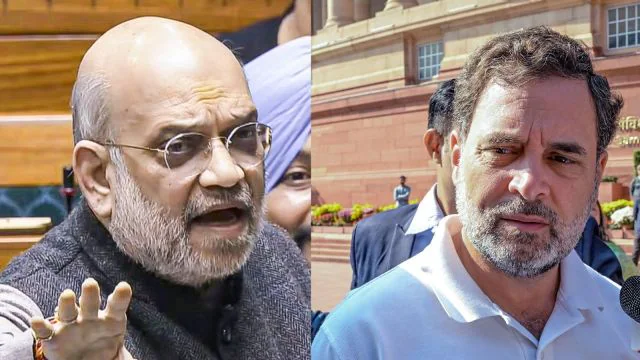
The speech was met with expected furor. Union Parliamentary Affairs Minister Kiren Rijiju accused Gandhi of wasting crucial discussion time, while Speaker Om Birla appealed for decorum. The protests from the Treasury benches, however, only served to underscore the deep fissures the address revealed.
Gandhi’s speech is more than a parliamentary performance; it is a strategic political document. It lays out the cornerstone of the INDIA opposition bloc’s campaign narrative for the foreseeable future: that India is witnessing an “institutional emergency.” The promise of retrospective legislation is a high-stakes gamble, signaling an intent to pursue legal and political vengeance, which could mobilize their base but also attract criticism for mirroring the majoritarian tactics they oppose.
Analysis at a Glance: Key Charges and Implications
| Aspect | Rahul Gandhi’s Charge | Potential Government/BJP Rebuttal | Broader Democratic Implication |
|---|---|---|---|
| ECI Appointments | The removal of the CJI has “captured” the ECI, making it a government puppet. | The new system is more democratic, involving the LoP. Previous system was judicial overreach. | Debate on balancing independence with executive accountability in appointments. |
| Legal Immunity for EC | A unique law to protect commissioners from prosecution for any official act. | Necessary to allow fearless, impartial conduct without threat of vexatious litigation. | Creates a potential accountability gap for a constitutional body. |
| CCTV Footage Rule | Destruction of footage after 45 days destroys evidence of malpractice. | Standard data management and privacy practice; footage is reviewed during mandatory counts. | Reduces transparency and the possibility of post-election audit and verification. |
| Electoral Rolls | Presence of lakhs of duplicate/voter names proves systematic “vote theft.” | ECI conducts regular drives to clean rolls; anomalies are inevitable in a database of ~970 million. | Highlights need for more robust, transparent, and collaborative roll management. |
| EVM Transparency | Denying party access to EVM architecture fosters distrust. | EVMs are standalone, tested machines; architecture is disclosed to experts under ECI aegis. | Persistent trust deficit requires innovative solutions for verifiability. |
| Retrospective Law Threat | A promise to hold current rulers accountable for “anti-national” vote theft. | An admission of vindictiveness and a threat to the rule of law for political gains. | Raises questions about the use of state power for retribution vs. justice. |
The battle lines are now irrevocably drawn. The debate has moved beyond specific policy disagreements to a fundamental clash over the very mechanisms that guarantee democratic power transfer. Rahul Gandhi has positioned the Congress and the opposition as the defenders of a voting right under siege, vowing not just to reform but to retribute. Whether this narrative resonates with the electorate as a compelling call to save democracy or is dismissed as hyperbolic opposition politics will be one of the defining questions of Indian politics in 2025 and beyond. The Lok Sabha speech is not an end, but a declaration of a prolonged war for the soul of Indian democracy, with the Election Commission as its most contested battlefield.