

By Anushka Verma | Updated: October 29, 2025
Introduction
In a stunning revelation that could rewrite parts of our cosmic history, scientists in China have discovered something extraordinary hidden within the grey dust of the Moon’s far side — a fragment of rock older than our Solar System, containing traces of water. The discovery, made possible by China’s Chang’e-6 lunar mission, represents one of the most significant scientific breakthroughs of the decade.
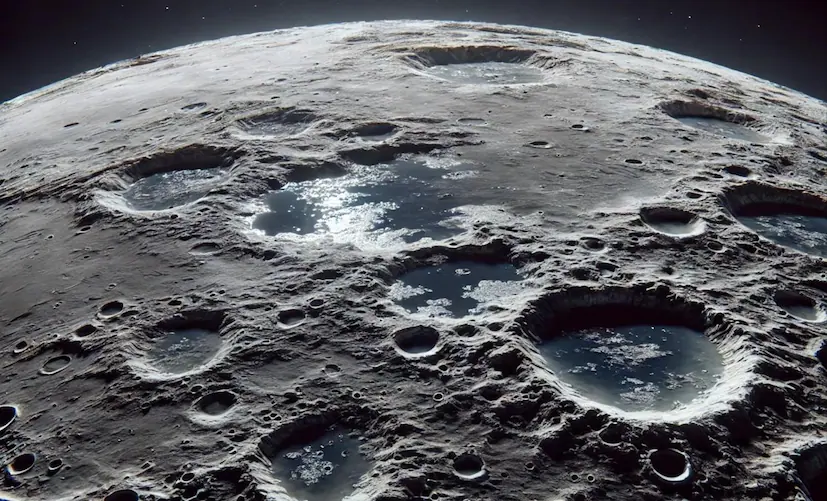
The rock fragment, retrieved from the South Pole–Aitken Basin — a massive crater on the Moon’s far side — holds invaluable clues to understanding how Earth and its sister worlds formed billions of years ago, and more importantly, how water first reached our planet. Researchers believe this finding could be worth billions for science, not in monetary terms, but for its unmatched potential to transform our knowledge of planetary origins and the conditions that made life on Earth possible.
The Far Side of the Moon — The Last Great Mystery
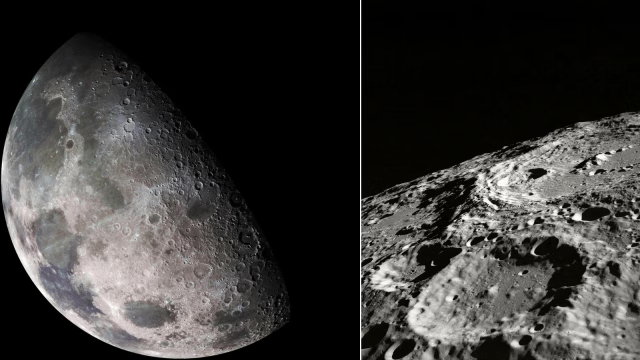
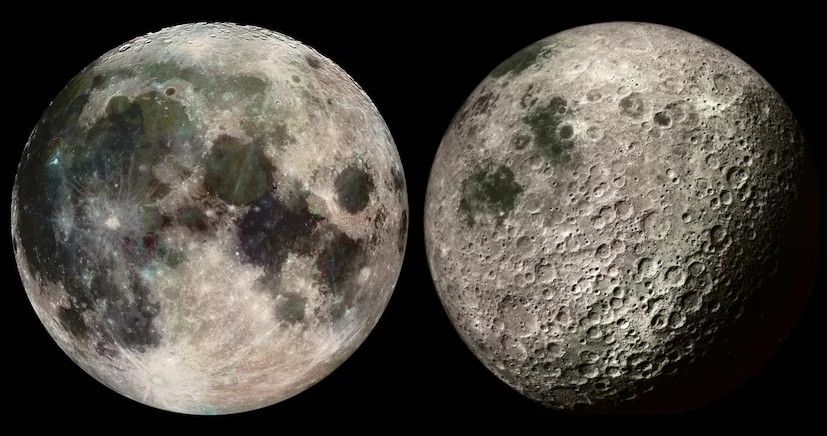
For centuries, the Moon has inspired curiosity, myth, and exploration. Yet, until recently, half of it remained completely hidden from human eyes. The far side, often mischaracterized as “the dark side,” is not truly dark — it simply never faces Earth due to the Moon’s synchronous orbit.
This unexplored half has always been a scientific enigma. Unlike the near side, which is smoother and filled with large volcanic plains (the “maria”), the far side is rugged, densely cratered, and largely untouched since the Moon’s formation. Scientists have long speculated that the far side could preserve ancient material, shielded from solar radiation and meteorite impacts that have reshaped the near side over eons.
Enter Chang’e-6, the mission that finally lifted the veil.
The Chang’e-6 Mission: China’s Historic Leap
Launched by the China National Space Administration (CNSA) in 2024, Chang’e-6 became the first spacecraft in human history to collect and return samples from the far side of the Moon. After landing in the South Pole–Aitken Basin, it used advanced drills and robotic arms to collect rock and soil, carefully sealing them in vacuum-tight containers to prevent contamination.
The mission’s return capsule touched down safely on Earth in June 2025, carrying 1.9 kilograms of lunar material — material that had never before been touched or studied by humankind.
When Chinese scientists began examining the samples, they expected to find new insights into lunar geology. What they didn’t expect was a tiny, ancient meteorite fragment embedded within the lunar soil — one that appeared to be older than the Moon, the Earth, and even the Sun itself.
The Discovery: A Rock Older Than the Solar System
Under high-resolution electron microscopes and isotopic analysis tools, the research team found something remarkable: isotopic ratios and mineral compositions that did not match any known lunar or solar material.
This pointed to a pre-solar origin — a rock formed before the birth of our Solar System, about 4.6 billion years ago. In cosmic terms, this is a messenger from a time when stars and planets were still forming out of the swirling cloud of dust and gas that became our Solar System.
The fragment’s structure contained microscopic inclusions of water molecules — a detail that shocked researchers. The water wasn’t in liquid form, of course, but bound within the mineral crystals, trapped there for billions of years like a time capsule from the dawn of creation.
Why the Water Discovery Matters
Water is more than just a molecule — it’s the foundation of life as we know it. Its presence in such an ancient rock suggests that water existed in the universe long before the formation of the Solar System.
This discovery strengthens the long-debated theory that Earth’s water didn’t originate here, but was delivered through asteroids, comets, and meteorites that bombarded the young planet billions of years ago.
If the pre-solar meteorite fragment on the Moon indeed came from interstellar space, it could serve as direct evidence that the same type of cosmic material that delivered water to Earth also reached the Moon.
This means that the building blocks for oceans — and potentially for life — were already circulating in the universe before the Sun even existed.
A Pre-Solar Messenger: How Scientists Confirmed the Origin
The confirmation of the rock’s pre-solar origin came through a combination of isotopic ratio analysis and mineralogy.
Researchers identified oxygen and hydrogen isotope ratios that were significantly different from lunar or terrestrial samples. These ratios are characteristic of materials formed in cold interstellar environments — regions filled with dust, ice, and gas, where temperatures are just a few degrees above absolute zero.
Under such extreme conditions, microscopic dust grains coated with ice can fuse together over millions of years, eventually forming the seeds of asteroids and planets. The rock fragment discovered by Chang’e-6 likely originated from such a place, billions of years ago.
When the early Solar System formed, this material became trapped in larger bodies — some of which were later ejected as meteorites that struck the Moon’s surface. There, shielded from Earth’s geological activity, they remained perfectly preserved until now.
Comparison with Previous Lunar and Martian Findings
This is not the first time water has been detected on extraterrestrial bodies, but it’s the first time water has been found in a pre-solar rock on the Moon’s far side.
- NASA’s Apollo missions had earlier found traces of water in volcanic glass beads from the Moon’s near side, but these were younger and lunar-born.
- Martian meteorites found on Earth have shown signs of ancient water, suggesting Mars once hosted flowing rivers and lakes.
- Asteroids like Bennu and Ryugu, visited by NASA and JAXA missions, also contained hydrated minerals — evidence that water was widespread in the early Solar System.
However, none of those discoveries match the pre-solar timeline of this new fragment. This means that the Chang’e-6 find doesn’t just push the boundary of when water existed — it moves it beyond the birth of the Solar System itself.
What This Discovery Tells Us About Earth’s Origins
The existence of water in a rock older than the Sun suggests a profound truth: the ingredients for life on Earth were not unique or accidental.
Instead, they were part of the natural chemistry of the universe — formed in ancient clouds of dust and gas, distributed by stellar winds, and delivered across space through meteorites.
This supports a growing scientific idea called “cosmic panspermia”, which proposes that life’s essential ingredients — water, carbon, and organic molecules — were seeded across the universe long before planets formed.
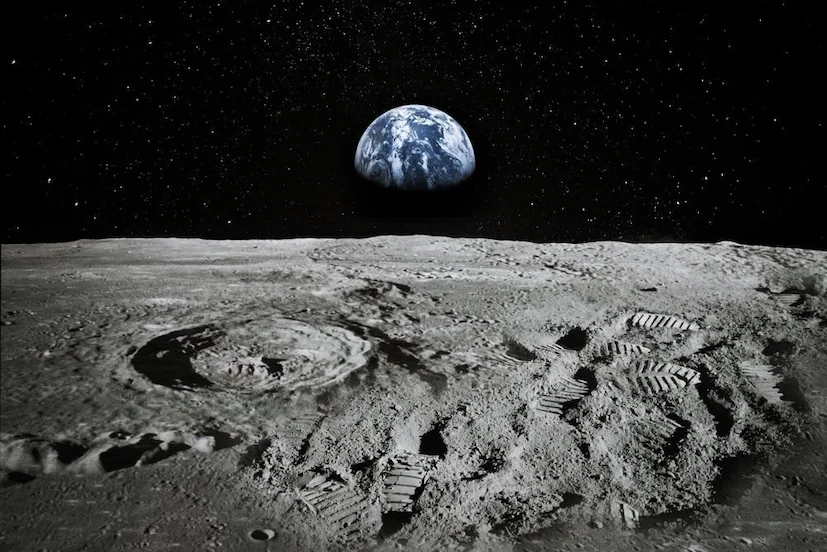
The Moon, unlike Earth, has no atmosphere, plate tectonics, or erosion to disturb its surface. This makes it a perfect cosmic archive, preserving ancient material that has long vanished from our planet’s crust.
Thus, by studying the Moon, scientists can peer billions of years into the past — into the history that shaped Earth itself.
The Science Behind the Analysis
The research teams used a combination of spectroscopy, scanning electron microscopy (SEM), and isotopic mass spectrometry to analyze the samples.
Through infrared spectroscopy, they detected the unique vibrational signature of hydroxyl (OH) groups — an indicator of water bound to minerals.
Further isotopic testing revealed deuterium-to-hydrogen (D/H) ratios consistent with pre-solar materials found in interstellar comets and asteroids. This signature acted like a cosmic fingerprint, confirming that the water did not originate on the Moon or from the Solar System, but from an older, interstellar source.
This level of precision analysis was made possible by new ultra-high-resolution spectrometers developed in China, marking another milestone in the nation’s rapidly advancing space science capabilities.
Global Reactions and Scientific Impact
The discovery immediately drew attention from the international scientific community. NASA, ESA, JAXA, and Indian ISRO scientists praised the finding as “a once-in-a-generation scientific treasure.”
Dr. Elena Pérez from the European Space Agency called it “a Rosetta Stone for planetary science,” saying that “this discovery bridges the gap between star formation and planetary evolution.”
American geochemist Dr. Robert Whitmore noted that “finding water in a rock older than the Sun completely redefines how we think about planetary formation — it’s like finding DNA that predates life itself.”
Even critics of China’s space program admitted that this discovery is a triumph of global significance, one that transcends national pride and unites humanity’s quest to understand our origins.
The Economic and Strategic Value — Science Worth Billions
While scientists emphasize that such discoveries can’t be measured in currency, there’s no denying their immense intellectual and strategic value.
Governments and space agencies have already estimated that the scientific worth of these samples exceeds several billion dollars — in terms of the technology, data, and insight they can generate.
Each gram of lunar soil is more valuable than gold when it comes to unlocking the mysteries of creation. Understanding pre-solar materials could eventually lead to new materials science innovations, better models for planetary formation, and even clues to the origins of extraterrestrial life.
Moreover, the discovery cements China’s position as a global leader in space research, and sets the stage for a new era of international collaboration on lunar exploration.
Future Missions and the Path Ahead
Following the success of Chang’e-6, China has already announced plans for Chang’e-7 and Chang’e-8, which will explore the lunar south pole for signs of ice and underground water reserves.
NASA’s Artemis Program and India’s Chandrayaan-3 follow-ups are also expected to focus on similar regions, with an emphasis on understanding how water can support future lunar habitats and space colonization.
This discovery adds new urgency to these missions — because if the Moon holds ancient interstellar materials, each scoop of lunar dust could contain secrets about the origins of life itself.
Unanswered Questions
Even as scientists celebrate, several questions remain:
- How did the pre-solar rock end up embedded in lunar soil?
- Could there be more fragments like it hidden beneath the Moon’s surface?
- Does this water share isotopic similarities with Earth’s oceans, confirming a common source?
- And perhaps the most profound — could other pre-solar materials still carry organic molecules, hinting at life’s earliest chemistry?
These questions ensure that the search has only just begun.
Conclusion: A Drop of Water That Rewrites History
In the vast silence of space, a tiny rock carried a secret for over four and a half billion years — a whisper from a time before the Sun burned, before Earth formed, before life existed.
Now, thanks to the precision and ambition of human exploration, that whisper has become a revelation.
The discovery of water in a pre-solar rock on the Moon’s far side is not just a milestone in science — it’s a reminder of our connection to the cosmos. Every drop of water we drink, every ocean wave that touches our shores, may trace its ancestry to the same interstellar dust that now sits quietly within a rock found on the Moon.
As scientists continue to analyze these samples, one thing is clear:
the Moon has once again become a mirror — not of light, but of time itself.
And in that reflection, we see not just the story of the Moon, but the story of us all.