


By: Anushka Verma | 13 November 2025
Introduction
Bihar witnessed a political and social phenomenon that will likely be remembered as a turning point in the state’s democratic evolution. The 2025 Bihar Assembly election ended with a historic overall voter turnout of 66.91%, the highest ever recorded. But beyond the headline figure lies the real story: a breathtaking surge in women’s participation. Women voted at 71.6%, outperforming men (at 62.8%) by a staggering 8.8 percentage points. This is the widest gender turnout gap in Bihar’s electoral history, surpassing even the celebrated 2015 election when women outvoted men by 7.16 points.
This year, the gap is not just numerical — it is symbolic of a profound social transformation. Early estimates indicate that more than 5 lakh additional women voted compared to men, making the female electorate the strongest single demographic force influencing the outcome of this election. Political parties — including the NDA, JDU, BJP, RJD, Congress, and the INDIA bloc — now face a new reality: Bihar’s women are no longer a silent constituency. They are the most decisive voters in the state.
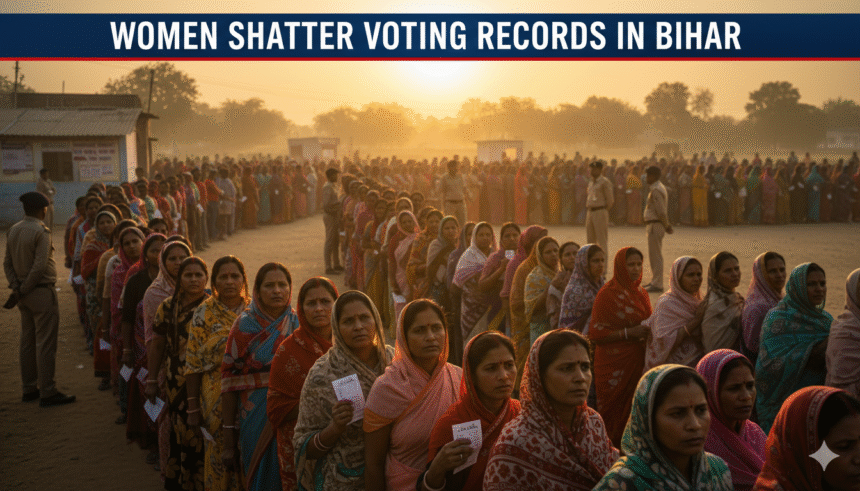
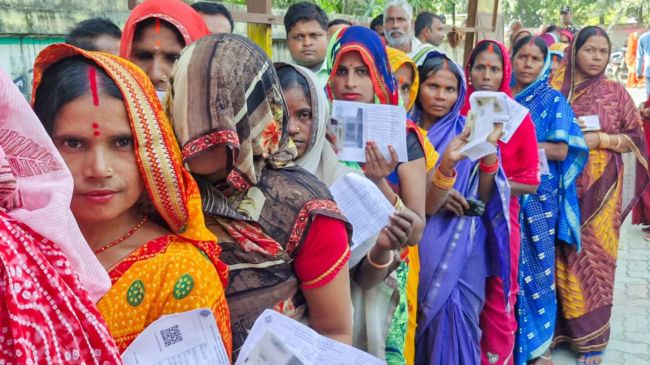
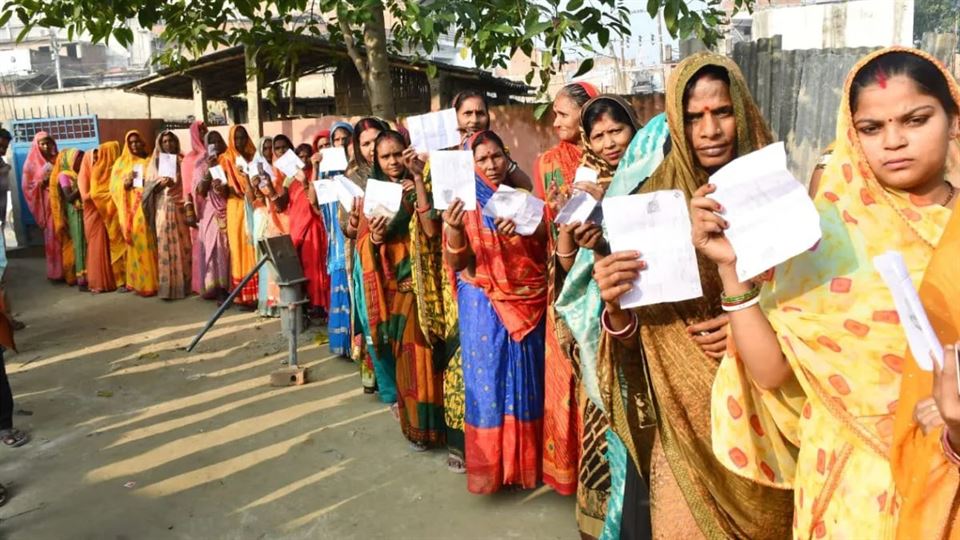
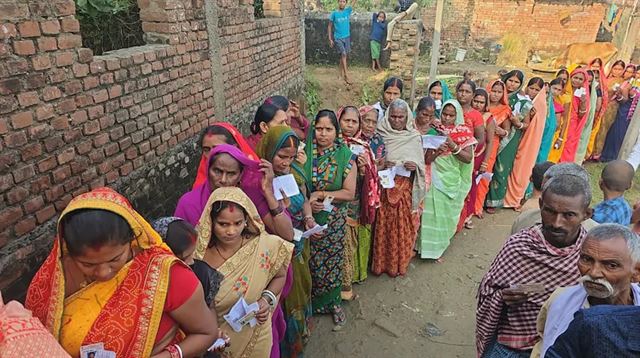
From the first hour of polling to the closing minutes, Bihar’s landscape told the same story everywhere: women standing in lines longer than usual, often with children in their arms or aged relatives by their side. Scenes from West Champaran, Gopalganj, Madhubani, Katihar, Muzaffarpur, and Vaishali captured an unmistakable trend — women voting early, voting in large numbers, and voting with clarity of purpose.
This report explores the scale, causes, and implications of this remarkable surge in women’s political participation through long-form narrative journalism, field insights, sociological perspectives, and political analysis.
A Record Broken: The Numbers Behind the Women’s Wave
The raw figures themselves reveal a powerful story. A voter turnout of 66.91% marks a new record for Bihar, but that achievement has been driven almost entirely by women. With 71.6% of eligible women casting their vote, this election represents a dramatic continuation of a decade-long trend in which women have steadily overtaken men in electoral participation.
The Historic Gap
- Women: 71.6% turnout
- Men: 62.8% turnout
- Difference: +8.8 percentage points (largest ever)
This difference alone is enough to sway the outcome in dozens of constituencies. Across the 243-seat Bihar Assembly, at least 70–90 seats are expected to be heavily influenced by women voters due to narrow margins and high female turnout.
Surpassing 2015
The previous record — 2015 — had been considered a landmark moment when women outperformed men by 7.16 percentage points. But 2025 surpasses even that, signalling that what began as a trend is now an entrenched behavioural shift.
Ground Reality: Scenes from Polling Day
Across Bihar, polling stations saw overwhelming female presence. At many booths, women outnumbered men by nearly 2:1 in morning hours.
Below are narratives from the ground that highlight the intensity of women’s participation.
West Champaran: Women Waiting Before Dawn
At a school-turned-polling station in West Champaran, more than 200 women were already waiting by 6:30 a.m. “Hum pehle aa jaate hain, kaam bhi hota hai aur vote bhi dena hai,” said 32-year-old Sunita Devi, holding her three-year-old child. When asked why she considered voting so important, she replied:
“Vote hi hamari awaz hai. Isse ghar bhi badhega aur zindagi bhi.”
Muzaffarpur: First-Time Women Voters Show Confidence
In Muzaffarpur’s Kanti area, 18-year-old Aarti Kumari walked confidently with her college friends.
“Yeh hamara pehla vote hai. Hum chahte hain ki hamari generation ki problems ko koi seriously le,” she said, expressing concerns about safety and job opportunities for young women.
Supaul: Elderly Women Steal the Show
At a Supaul booth, 74-year-old Kamla Devi insisted on walking unassisted, despite offers of a wheelchair.
“Main vote dene apne pair se aayi hoon. Jab tak saans chalti hai, vote denge.”
Such voices echo across the state, showing not only enthusiasm but also political agency.
Why Women Outvoted Men: The Silent Social Revolution
The unprecedented turnout is rooted in a combination of socio-economic changes, welfare policies, mobility improvements, and rising awareness.
1. Mobility Improvements
The last decade has seen road expansions, last-mile connectivity improvements, and the widespread use of bicycles by girls due to government schemes. Women no longer depend on male family members to accompany them.
This autonomy directly translates into voting independence.
2. Welfare Schemes Directly Targeting Women
Governments from both sides — NDA and INDIA bloc constituents — have invested in women-centric schemes. These include:
- free and subsidised LPG cylinders
- maternal health benefits
- nutrition programs
- widow and old-age pensions
- schemes for self-help groups (SHGs)
- women’s property ownership clauses in housing schemes
Women perceive these schemes as tangible outcomes of governance, making them more politically aware and active.
3. Economic and Social Aspiration
Women are voting not out of duty but out of aspiration. They associate voting with:
- better safety
- improved household economy
- children’s education
- stable infrastructure
- freedom of mobility
They see voting as a tool to shape their socio-economic environment.
4. Reduction of Caste-Based Voting Among Women
While men often continue voting along caste lines, women increasingly base their choices on:
- welfare benefits
- governance performance
- family wellbeing
- safety conditions
This shift is transforming Bihar’s political landscape in unpredictable ways.
Political Impact: How Women Are Rewriting Electoral Strategy
The massive surge in female turnout has forced every political party to focus heavily on women voters.
NDA’s Calculation
The NDA’s campaigns centred on welfare delivery, PM Ujjwala Yojana, toilets, tap water, rural road connectivity, and women’s safety. NDA leaders repeatedly highlighted how women benefitted from central schemes.
RJD and INDIA Bloc’s Strategy
The opposition INDIA bloc, led by RJD and Congress in Bihar, emphasised unemployment, price rise, and the need for stronger public welfare systems. They sought to capture the support of female youth and SHG workers through promises of job creation and better social security.
JDU’s Stronghold Among Women
Nitish Kumar’s JDU has historically enjoyed strong support among female voters due to long-running programs focused on girl-child education, prohibition laws, bicycle schemes, and improved policing for women.
Women as Decisive Swing Voters
In nearly 80 constituencies, women voters exceed men by 5,000–20,000.
This makes them the decisive swing factor irrespective of party alignments.
Political analysts agree that no party can form a stable government in Bihar anymore without commanding the trust of women.
Comparing Past Elections: The Decade of Women Voters
Women voting in greater numbers is not new — but the intensity is.
| Year | Women Turnout | Men Turnout | Gap |
|---|---|---|---|
| 2010 | 58% | 54% | +4% |
| 2015 | 60.48% | 53.32% | +7.16% |
| 2020 | 59.9% | 54.7% | +5.2% |
| 2025 | 71.6% | 62.8% | +8.8% |
The leap from 2020 to 2025 is extraordinary — a jump of almost 12 percentage points among women.
Sociological Shift: Women as Independent Political Actors
Women in Bihar are asserting themselves politically in ways previously unimaginable.
Breaking Dependency
Earlier, women’s political choices were often influenced by male family members. But improved literacy, SHG participation, smartphone penetration, and exposure to media have given women their own political calculations.
The Rise of SHG Networks
Self-help groups have turned into political education platforms where women:
- discuss governance
- understand schemes
- share information
- mobilize each other
This grassroots information network is more powerful than any party campaign.
Ground Voices: What Women Really Want
Across districts, women voters expressed similar expectations.
Employment for Youth
“Humare bachchon ko kaam mile, yahi sabse bada mudda hai,” said a Gaya voter.
Improved Safety
Women across Patna, Muzaffarpur, and Darbhanga emphasised better policing and street lighting.
Stable Price Levels
Inflation directly affects household budgets, making it a core voting issue for women.
Education and Healthcare
Women strongly associate governance performance with the quality of schools and hospitals in their districts.
What This Means for Bihar’s Political Future
Women are now:
- the largest voting bloc
- the most consistent voting group
- the most welfare-responsive demographic
- the most independent and swing-heavy electorate
This fundamentally changes Bihar’s political arithmetic.
Whichever party wins — NDA or INDIA bloc — will owe its success to women voters.
Whichever party loses will likely lose because it failed to convince them.
Conclusion
The 2025 Bihar Assembly election will be remembered not just for its record turnout, but for the overwhelming and decisive participation of women voters. Their turnout of 71.6%, exceeding men by 8.8 percentage points, represents far more than a numerical achievement. It is a declaration of political agency, social transformation, and democratic empowerment.
The women of Bihar have sent a message — clear, confident, and historic:
They are no longer spectators. They are the authors of Bihar’s political future.


