



By Anushka Verma | New Delhi | Updated: October 30, 2025
Introduction
India’s growth story, which has long been hailed as one of the most resilient in the developing world, has encountered fresh headwinds. The World Bank has revised its FY27 GDP forecast for India downward to 6.3%, citing the ripple effects of a 50% tariff imposed by the United States and rising external economic pressures. However, even as the multilateral agency tempers its optimism, it acknowledges that India’s reform momentum — particularly in taxation, deregulation, and manufacturing — signals a clear intent to strengthen its economic fundamentals.
According to Franziska Ohnsorge, Chief Economist for the World Bank’s South Asia Region, India’s government “has shown a new sense of urgency in deregulation and reform implementation.” The Bank also slightly raised India’s current fiscal year growth projection to 6.5%, up from 6.3%, on account of stronger-than-expected Q1 growth of 7.8%.
At the heart of this update lies a broader question: What price will India pay for global trade tensions and protectionism, and can domestic reforms offset the slowdown?
Quick Summary Table
| Indicator | FY26 (Current Year) | FY27 (Next Year) | Agency/Source |
|---|---|---|---|
| World Bank GDP Forecast | 6.5% | 6.3% | World Bank (Oct 2025) |
| RBI GDP Forecast | 6.8% | 6.6% | Reserve Bank of India |
| US Tariff on Indian Goods | 50% | 50% (Expected FY27 impact) | US Trade Policy |
| India’s Trade Surplus with US (FY25) | $41 Billion | — | Ministry of Commerce |
| India’s GDP Q1 FY26 Growth | 7.8% | — | MOSPI |
| Key Policy Moves | Income Tax Cuts, GST Reduction, Deregulation Task Force | Ongoing Reforms | Govt. of India |
World Bank’s Revised Outlook: A Signal of Caution
The World Bank’s adjustment — trimming India’s FY27 growth outlook by 20 basis points to 6.3% — might appear minor at first glance. Yet, it reflects growing global uncertainty and the price India could pay for external disruptions.
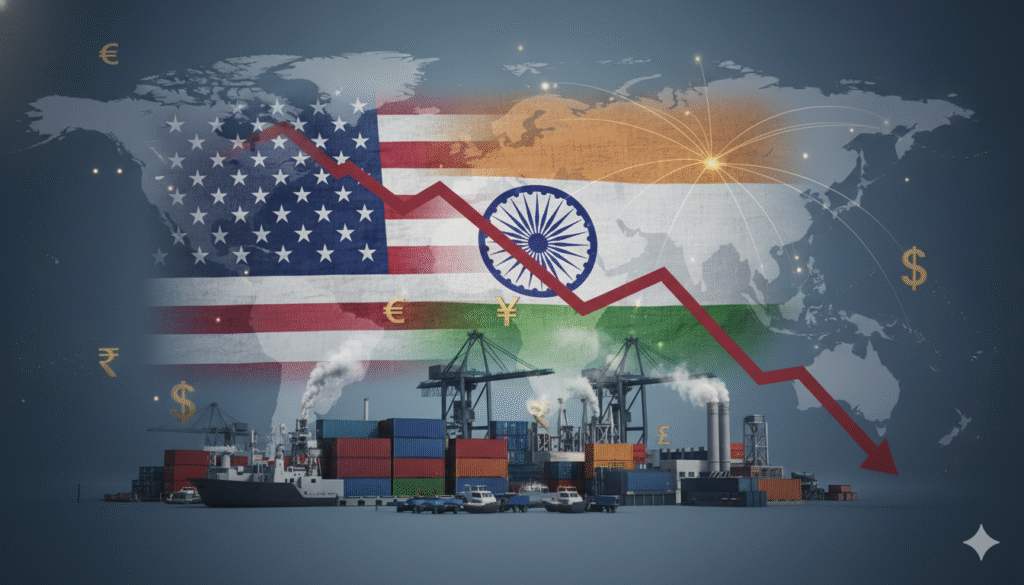
The newly imposed US tariffs, a consequence of President Donald Trump’s renewed trade nationalism, have rattled exporters worldwide. India, facing a 25% tariff on imports of Russian oil and arms, along with a reciprocal 25% tariff on its goods to the US, stands exposed to shifting trade equations.
“While India is relatively insulated from global markets compared to other emerging economies, a global slowdown would still affect its growth trajectory,” Ohnsorge noted.
This cautious tone comes even as India’s domestic demand and investment climate remain buoyant, largely supported by public capex, private consumption, and policy-driven reform measures.
Reform Push: The Domestic Engine Still Roars
Despite global uncertainties, the Indian government continues to power its economic engine through proactive reforms. In 2025 alone, several crucial policy decisions were implemented to stimulate domestic consumption and improve ease of doing business.
Key Reforms in 2025:
- Union Budget 2025-26: Personal income tax rates were reduced under the new regime, aimed at boosting disposable incomes and encouraging spending.
- GST Council Decision (September 2025): The council slashed GST rates across multiple categories, effective September 22, easing the tax burden for consumers and MSMEs.
- Reform Committees and Task Forces:
- Rajiv Gauba Committee (under NITI Aayog) submitted reform blueprints focusing on deregulation and labour reforms.
- Informal Groups of Ministers, led by Amit Shah (Economic Reforms) and Rajnath Singh (Social Sector Reforms), are driving cross-ministerial policy coordination.
- Task Force on Deregulation established to remove bottlenecks in trade, licensing, and compliance.
These efforts signal that India’s reform narrative remains robust, even in the face of global economic turbulence.
External Shocks: The Price of Global Trade Realignment
While reforms can cushion internal growth, India’s biggest vulnerabilities lie beyond its borders. The return of Trump to the US presidency has reignited a trade war-like environment, with the world’s largest economy imposing sweeping tariffs to balance its trade deficit.
India’s $41 billion trade surplus with the US, once seen as a strength, has now become a target of American trade pressure. Trump’s administration has sought bilateral deals demanding reciprocal investments in US manufacturing — a model that tilts the playing field in Washington’s favour.
For India, these tariffs are not just about lost exports; they represent a potential slowdown in FDI inflows, rising import costs, and reduced competitiveness of Indian manufacturers in global markets.
Comparing Forecasts: RBI vs. World Bank
| Institution | FY26 Forecast | FY27 Forecast | Commentary |
|---|---|---|---|
| World Bank | 6.5% | 6.3% | Cautious due to global risks and US tariffs |
| RBI | 6.8% | 6.6% | Optimistic on domestic demand and monsoon normalcy |
| IMF (Previous Estimate) | 6.7% | 6.5% | Structural resilience and reform impact |
The RBI’s more optimistic stance stems from its belief in India’s domestic consumption cycle and strong macroeconomic fundamentals. However, the World Bank’s conservative view serves as a timely reminder that global integration comes with vulnerability.
Manufacturing: The Key to Unlocking Jobs and Growth
One of the report’s most striking recommendations comes from Ohnsorge’s emphasis on export-led manufacturing. She argues that India’s pathway to sustainable, inclusive growth lies in boosting manufacturing for exports, which could simultaneously attract FDI and generate employment.
“Manufacturing for export could create the millions of jobs India needs,” Ohnsorge said.
However, she cautioned that this would require a big policy decision to make importing and exporting easier, especially by reducing tariffs on intermediate goods — which remain twice as high as the emerging market average.
This recommendation aligns with India’s “Make in India 2.0” vision, which focuses on integrating Indian manufacturers into global value chains. The push to sign trade agreements with the UK, EU, Australia, and Canada also underlines this outward-looking strategy.
India’s Trade Equation: Between Protection and Progress
The World Bank’s South Asia Development Update makes a nuanced observation: India’s trade openness is both its strength and weakness. On one hand, it shields the country from external shocks due to its diversified domestic economy; on the other, it limits its ability to capitalize on global export opportunities.
India’s average tariff rate remains significantly higher than peers like Vietnam and Indonesia — nations that have leveraged low tariffs and aggressive trade pacts to dominate global supply chains.
To “meaningfully move the needle,” Ohnsorge noted, India must not only lower tariff barriers but also address non-tariff constraints such as:
- Licensing delays
- Complex compliance norms
- Unpredictable taxation
- Infrastructure bottlenecks at ports and logistics hubs
Reforms Pipeline: What Lies Ahead
Upcoming Measures (Expected Before Diwali 2025):
- Second Phase of GST Simplification for micro-enterprises
- Labour Code Implementation Framework across all states
- Ease of Doing Business Index 2.0 under NITI Aayog to benchmark states
- Digital Regulatory Dashboard to simplify compliance tracking
According to B.V.R. Subrahmanyam, CEO of NITI Aayog, these upcoming steps “will redefine India’s reform landscape” and make it easier for businesses to operate with transparency and minimal bureaucracy.
The FDI Factor: Slowing Inflows, Rising Expectations
India’s FDI inflows, once a major growth catalyst, have shown signs of slowing in 2025. While sectors like renewable energy, fintech, and semiconductors remain attractive, manufacturing-linked investments have plateaued amid global uncertainty.
| Year | FDI Inflows (USD Billion) | Key Sectors |
|---|---|---|
| FY23 | 70.9 | Services, IT, Energy |
| FY24 | 67.5 | Infrastructure, Green Tech |
| FY25 (Est.) | 64.2 | Manufacturing, Textiles, Startups |
The World Bank emphasizes that policy consistency, reduction in trade barriers, and faster FTA negotiations could revive investor sentiment.
Balancing Growth and Stability: India’s Tightrope Walk
India’s challenge now lies in balancing high domestic aspirations with external vulnerabilities.
While the economy remains one of the fastest-growing major markets, structural reforms, supply-side efficiency, and global competitiveness will determine its trajectory over the next decade.
Experts believe that the real price India must pay is not only in growth numbers but in lost opportunities if reform momentum slows or global integration lags.
“India’s long-term potential is undiminished,” said Ohnsorge. “But realizing it will require persistent reforms and global cooperation.”
Conclusion: The Price of Resilience
As the World Bank trims its growth forecast, India stands at a crossroads. The price of global protectionism, trade frictions, and tariff barriers could slow near-term growth — but the dividends of reform, deregulation, and manufacturing transformation can secure long-term prosperity.
In the words of one senior economist:
“India is not just navigating global headwinds — it’s designing a new growth model that blends reform urgency with resilience. The next two years will decide whether that vision becomes reality.”


