


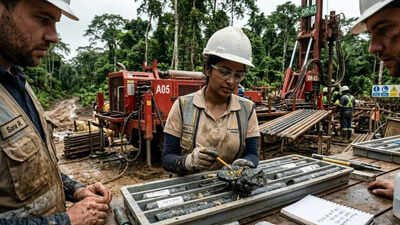
The discovery of a large deposit of high-grade gold at the site known as Maria Geralda, located in the southeastern region of Suriname, has been made by a team of geologists. The drill results at the site yielded an intercept of 22.5 metres at 11.88 grams of gold per tonne as reported by Founders Metals.
This is much greater than the typical standards (between 1 and 2 grams per tonne) used for operating gold mine operations. This discovery has opened up new areas of understanding for the Marowijne Greenstone Belt and will likely provide opportunities for future development of resources in this part of Suriname, which maintains a mining-dependent export economy. This discovery bolsters Suriname’s economic potential, highlighting the geological richness of the Marowijne Greenstone Belt for sustainable resource sector expansion.
Guiana Shield traps gold at Maria Geralda in Suriname
As noted in a news release published by Founders Metals, the Maria Geralda prospect within the Antino Gold District is identified as being located within the Guiana Shield (Paleoproterozoic) in the framework of a large tectonic event resulting from tectonic accretion during the Paleoproterozoic era to form multiple generations of faults and fractures. Structural features developed as ductile-shear and brittle-fracture systems produce quartz vein systems capable of trapping gold.
A recent program of mechanical auger drilling provided a robust three-dimensional structural model identifying potential high-grade mineralised shoots, confirming the presence of free gold and associated sulfide minerals.
How ancient Orogeny shaped Suriname’s gold deposits
The Guiana Shield represents one of the world’s most significant Paleoproterozoic cratons in the world, covering parts of Suriname, Guyana, French Guiana, Venezuela, and northern Brazil.
The geology of the Guiana Shield is controlled by the Paleoproterozoic greenstone belts (volcano-sedimentary sequences), which are highly prospective for orogenic gold systems; the formation of the Trans-Amazonian Orogeny (2.18 and 2.07 billion years ago) shaped both the fault and fracture systems and formed the conduits for gold-bearing fluids.
These structural features continue to be a key exploration target for current geochemical studies in the area.
Economic significance of the Marowijne Greenstone Belt
According to the Suriname Ministry of Natural Resources, the economy of Suriname relies heavily on gold mining; this sector has a major contribution towards the country’s total national export revenue and is also a source of taxes for the government from mining proceeds. Over the years, artisanal mining has also occurred across many of the historical Marowijne Greenstone Belt areas; only recently have some larger companies begun their first large-scale open-pit operations at Maria Geralda. Due to the current discovery of these large, high-grade ore bodies like those found at Maria Geralda, this will be extremely important to the country’s economy in the future, as it will stimulate further development of roads and provide jobs for people living in remote villages and towns, provided that environmental and community consultation standards are upheld.