

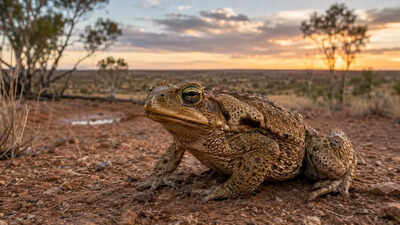
Australia’s inland edges are still, almost indifferent to change, where heat sits over the ground for long stretches and movement feels slow even when it is not. Yet in these same places, something introduced nearly a century ago has been steadily rewriting its own limits.
The cane toad arrived with a very specific job attached to it, carried in on scientific optimism and agricultural urgency. That intention did not survive contact with the landscape. What followed was a spread that never really paused, only adjusted its pace, finding waterholes, roadside ditches, suburban lawns, and everything in between. Somewhere along that expansion, the animal itself began to shift in small but measurable ways.
Australia’s cane toads were released to control beetles in sugarcane fields
As reported by Australian Geographic, back in the 1930s, cane toads were released in northern Queensland as a form of biological control. Sugarcane fields were under pressure from beetles, and the idea was simple enough on paper: introduce a predator that might keep the pests in check. The calculation did not hold for long. The toads ignored the beetles that had been the reason for their journey and instead turned to whatever was available, while adapting quickly to a country that offered far fewer natural checks than their original range.
What started in a narrow agricultural context widened almost immediately. Releases multiplied in the early years, and the animals moved outward faster than anyone had expected, crossing ecological boundaries that had no real defence against them.
How reproduction fuels the cane toad expansion in Australia
Over time, their presence stretched from the tropical north into vast inland corridors. Queensland became firmly established territory, and from there, it pushed into parts of the Northern Territory, the Kimberley region, and stretches of New South Wales.
The numbers are now counted in the hundreds of millions, although the exact figure shifts depending on rainfall and breeding conditions.Part of the explanation lies in how quickly they can reproduce once conditions allow it. The breeding cycle is short and intense. Tadpoles gather in dense groups in shallow water, feeding and growing in conditions that would be limiting for many native species. Once they reach adulthood, females can release thousands upon thousands of eggs in a single clutch, and this can happen more than once in a year.Native frogs in the same regions tend to operate on a far smaller scale. Their reproductive output is lower, and their timing is often tied more closely to specific seasonal windows. Cane toads do not appear to follow that same restraint. When water is present, they use it, and when it disappears, they wait it out in soil or shelter until it returns.
How cane toads in Australia began to evolve on the move
In recent decades, attention has turned not just to how far cane toads have spread, but how quickly they now move.
There is a noticeable difference between populations at the centre of their range and those at the leading edge of expansion. One trait that has drawn particular interest is leg length. Toads at the expanding boundary of their distribution have been observed with longer hind limbs compared with those in older, established populations. It is a subtle shift rather than a dramatic one, but it matters in terms of movement.
Longer legs allow for longer hops and greater sustained travel across open ground.The consequence of these changes is visible in the rate of spread. Reportedly, they have spread to a population of 200 million toads. Earlier estimates placed movement at around ten kilometres per year in some regions. More recent observations suggest that the leading edge can now cover distances several times greater than that.
Australia’s ongoing struggle to manage cane toad spread
Efforts to manage cane toads in Australia have taken many forms over the years, most of them with limited long-term success.
Physical removal can work locally, but rarely scales across the vast areas now inhabited by the species. Barriers and traps tend to offer only temporary relief.More experimental approaches have emerged in recent years. One of them involves what is sometimes described as conditioning native predators to avoid cane toads. In parts of northern Australia, scientists have trialled exposing young goannas to small, controlled encounters with the toads. The idea is not to eliminate the threat entirely but to allow the reptiles to experience the toad’s toxicity without fatal consequences, so that they learn to avoid them later in life.