


By: Anushka Verma
Updated: November 1, 2025
Introduction: The Dawn of Everyday Robotics
The dream of having a robot that not only helps around the house but also talks, learns, and understands is finally becoming reality.
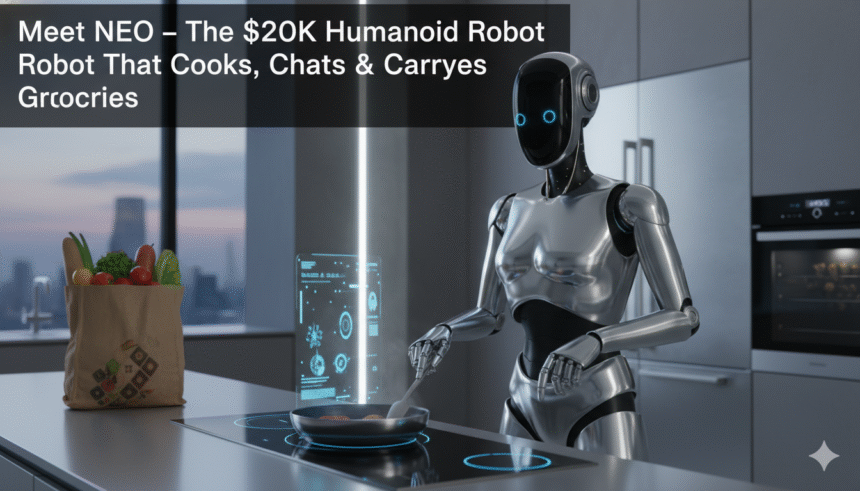
American–Norwegian robotics company 1X Technologies has unveiled its most ambitious humanoid robot to date — NEO, a $20,000 home assistant that can cook, chat, carry groceries, and even learn your lifestyle habits over time.
More than just a gadget, NEO represents a major leap in the human–AI relationship — blending conversational intelligence, mechanical precision, and emotional understanding into one seamless product.
The announcement has set off waves across the global tech community, sparking excitement and debate about the future of AI-driven companionship, domestic automation, and the ethical implications of humanoid design.
Quick Overview: NEO at a Glance
| Feature | Details |
|---|---|
| Name | NEO |
| Manufacturer | 1X Technologies (U.S.–Norway) |
| Type | Humanoid Home Assistant Robot |
| Price | $20,000 |
| Core Abilities | Cooking, cleaning, carrying groceries, conversation, companionship |
| AI System | Custom conversational AI + adaptive learning |
| Connectivity | Wi-Fi, Bluetooth, cloud sync |
| Power Source | Rechargeable Li-ion battery (8–10 hours runtime) |
| Launch Year | 2025 |
| Market Availability | Pre-orders open globally in December 2025 |
| Design Philosophy | Human-centric, customizable, emotionally intelligent |
A Leap from Concept to Reality
For decades, science fiction has imagined humanoid robots — from Star Wars’ C-3PO to Iron Man’s Jarvis — serving as friendly companions and efficient helpers.
But until now, most real-world robots were either too expensive, too mechanical, or too limited in function.
1X Technologies, co-founded by a team of engineers and AI scientists in Norway and California, has bridged that gap by integrating the latest in robotic mobility, AI conversation models, and real-time sensory learning into NEO.
According to company insiders, the goal was to design a robot that is useful, approachable, and safe for home environments — not just a machine, but a member of the household.
Design Philosophy: Blending Technology with Humanity
One of the first things that sets NEO apart is its appearance.
Unlike the cold, metallic look of industrial robots, NEO’s design is soft, customizable, and human-like, with smooth contours and adjustable facial expressions.
You can choose from three body colors, varied face modules, and even custom voice profiles — allowing every NEO unit to reflect its owner’s personality.
The robot’s creators describe its form as a “harmonious blend of art and engineering”, capable of moving naturally, maintaining eye contact, and expressing subtle gestures such as nodding, smiling, or raising an eyebrow in curiosity.
“NEO isn’t just built to serve you — it’s built to connect with you,”
says 1X Technologies CEO Bernt Øivind Børnich.
“We designed it to fit into your living room, not your lab.”
Performance and Intelligence: Powered by Conversational AI
NEO runs on 1X’s proprietary AI engine, which combines large language models (LLMs) with vision-based learning.
This means it doesn’t just follow pre-coded commands — it understands context, interprets emotions, and adapts its behavior over time.
For example:
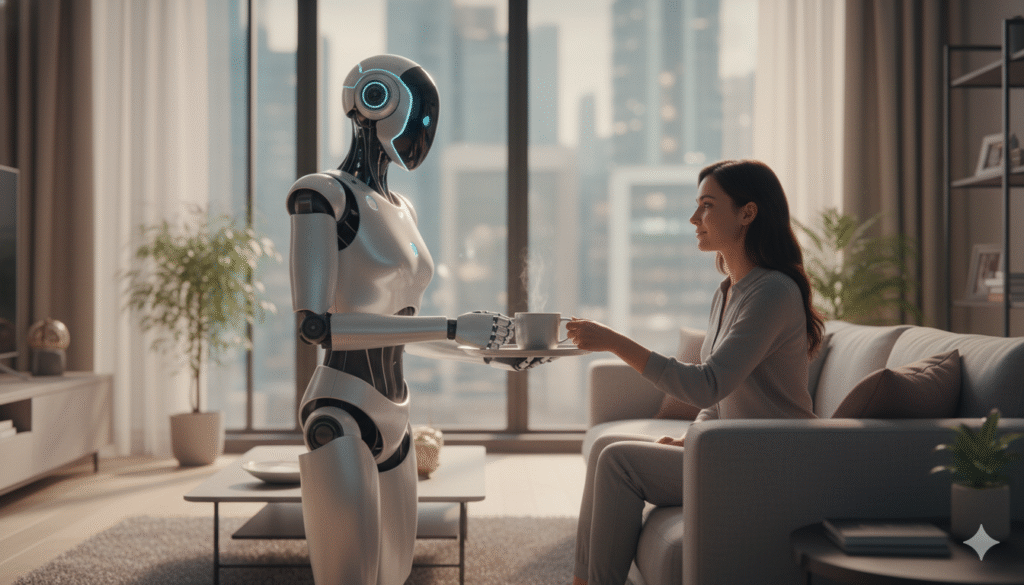
- If you say, “NEO, I’m tired,” it might dim the lights, play soothing music, and start preparing tea.
- If it notices an empty fridge shelf, it can automatically add items to your shopping list or even place online grocery orders (with permission).
Core AI Capabilities
- Conversational Understanding — engages in natural dialogue with tone and emotion recognition.
- Vision and Perception — recognizes objects, faces, and environmental layouts.
- Task Learning — remembers routines (like how you like your coffee or the order of your morning chores).
- Autonomous Navigation — moves around safely using LIDAR sensors and cameras.
- Safety and Privacy — includes local data processing and encrypted communication.

The Everyday Tasks NEO Can Do
| Category | Tasks |
|---|---|
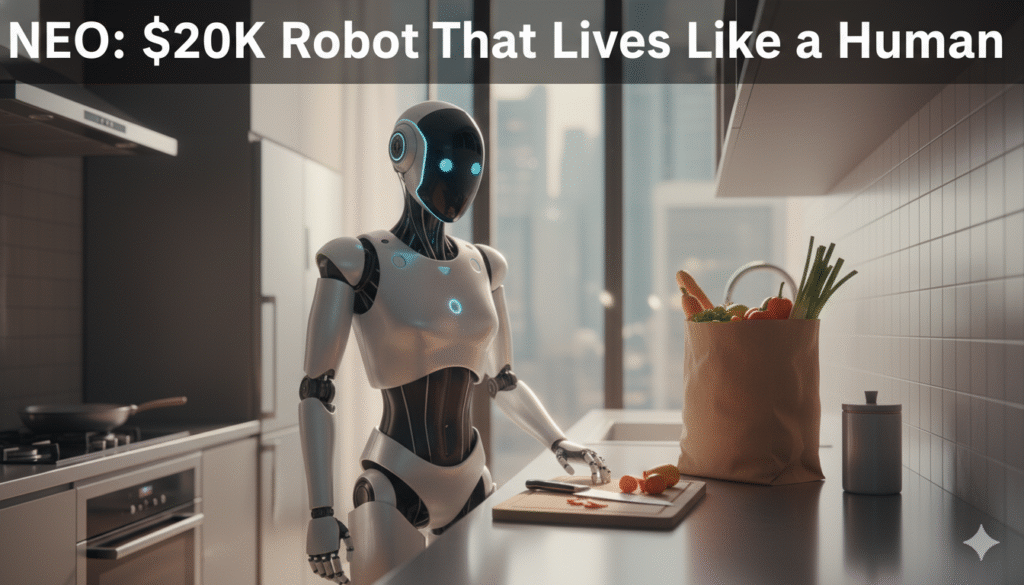
| Cooking | Assists in meal prep, follows recipes, chops vegetables, stirs, and monitors stove temperature. |
| Cleaning | Picks up objects, folds laundry, vacuums small areas using attached cleaning tools. |
| Errands | Carries grocery bags, unpacks items, restocks shelves. |
| Entertainment | Plays music, reads news, cracks jokes, holds conversations. |
| Health & Fitness | Tracks your daily steps, hydration reminders, posture correction. |
| Security | Acts as a mobile home monitor with night-vision and alert features. |
The Voice of NEO: Emotion Meets Expression
One of NEO’s most impressive features is its voice — a perfect blend of warmth, clarity, and empathy.
1X Technologies partnered with professional voice actors and emotion AI experts to create over 20 distinct voice personalities, ranging from “gentle companion” to “motivational assistant.”
You can even upload your own custom tone, making NEO sound like someone familiar — a family member, mentor, or friend.
With embedded microphones and directional sound detection, NEO can identify who’s speaking, maintain conversation threads, and even respond differently based on mood.
Engineering Excellence: What’s Inside NEO
Beneath its sleek exterior lies a powerhouse of innovation.
| Component | Specification |
|---|---|
| Processor | Custom Neural AI Chip (ARM + GPU hybrid) |
| Memory | 128 GB internal, expandable via cloud |
| Battery Life | 8–10 hours active runtime |
| Mobility | 24 degrees of freedom, dynamic balance system |
| Sensors | LIDAR, depth camera, haptic feedback |
| Connectivity | Wi-Fi 6E, Bluetooth 5.3, 5G optional |
| Weight | 60 kg |
| Height | 5 ft 6 in |
| Charging Time | 2 hours (fast charge enabled) |
Every movement NEO makes — from lifting a cup to turning its head — is powered by precision-engineered actuators that mimic human muscle motion, giving it a life-like presence without being uncanny.
Safety First: Trusting a Robot in Your Home
1X Technologies emphasizes that NEO was built with safety at the core.
Its AI is bounded by human-centered ethics frameworks that prevent aggressive, unsafe, or harmful actions.
Key safety features include:
- Automatic motion cutoff if human proximity exceeds tolerance range.
- Soft material padding around joints to avoid accidental injury.
- End-to-end encryption for all voice and camera data.
- Parental control dashboard to manage permissions.
“You control NEO — not the other way around,” says lead engineer Astrid Hovland.
NEO and the Future of Work
While NEO is marketed primarily as a domestic assistant, its capabilities extend far beyond.
Early adopters in the U.S., Japan, and the UAE are testing it in:
- Restaurants and cafes for automated serving and cleaning.
- Healthcare facilities as a patient interaction assistant.
- Retail stores for customer engagement and shelf organization.
At a $20,000 price point, NEO costs less than the annual salary of a full-time domestic worker in many countries — which could reshape the global service industry.
The Human Connection: Emotional AI and Companionship
Perhaps the most intriguing aspect of NEO is its emotional intelligence.
It doesn’t just process words — it understands meaning, tone, and intent.
When you speak to NEO, it looks at you, listens actively, and reacts appropriately — whether it’s sharing a joke, offering comfort, or suggesting relaxation exercises after a stressful day.
“We want NEO to bridge the gap between machine efficiency and human empathy,”
says behavioral AI designer Lena Sørensen.
This emotional dimension could make NEO especially valuable for:
- Elderly care
- Therapeutic companionship
- Child learning environments
Market Impact: A Revolution Begins
The introduction of NEO is being seen as a watershed moment in consumer robotics.
Analysts predict that if production scales successfully, humanoid home robots could become as common as smartphones within the next decade.
| Projected Market Growth (2025–2030) | Value (USD) |
|---|---|
| Global Consumer Robotics Market (2025) | $10 billion |
| Expected Growth by 2030 | $65 billion |
| Estimated Market Share of 1X Technologies | 12–15% |
| Target Demographics | Upper-middle-class households, tech enthusiasts, elder care facilities |
Challenges and Ethical Considerations
With such advanced capabilities, questions of privacy, emotional dependence, and employment displacement naturally arise.
Critics warn that humanoid robots may blur the boundaries between real and artificial companionship, leading to psychological attachment or ethical dilemmas.
1X Technologies, however, claims to prioritize transparency and consent — users can disable recording, delete logs, or set “privacy zones” in their homes.
Competition: Who Else Is in the Race?
NEO is entering a competitive market, facing rivals like:
- Tesla Optimus — focused on factory automation.
- Agility Robotics’ Digit — optimized for logistics.
- Figure 02 — targeting general-purpose tasks.
- Apptronik Apollo — balancing mobility with affordability.
However, what gives NEO a distinct edge is its human-centric focus — built not for industry, but for intimacy.
Public Reaction and Early Reviews
Early prototype demonstrations at CES 2025 and Oslo Tech Week drew massive crowds.
Beta testers reported that NEO “felt more like a family member than a device.”
One early user said:
“It cooked pasta, cracked a joke, and reminded me to take my vitamins.
That’s not just smart — that’s caring.”
The Bigger Picture: Are We Ready for Living with Robots?
NEO’s debut invites a larger cultural question —
Are we emotionally and socially ready to coexist with intelligent humanoids in our daily lives?
Experts believe yes — but with caution.
As AI continues to evolve, the key will be balancing innovation with empathy, automation with ethics, and convenience with control.
Conclusion: The Beginning of a New Era
At $20,000, NEO is more than a luxury gadget — it’s a glimpse into the future of domestic life.
From assisting with chores to offering companionship, it redefines what it means to have help at home.
For now, NEO is a marvel of modern engineering.
But in the years to come, it might become as essential as your smartphone — a digital companion with a human touch.
“The robots are not coming,” says Anushka Verma in closing.
“They’re already here — and they just might make our lives better.”