


By Anushka Verma | November 1, 2025
Introduction
In one of the most consequential strategic shake-ups in the technology industry, Microsoft and OpenAI have announced a sweeping revision to their partnership agreement — introducing an independent oversight panel to verify any future claims of achieving Artificial General Intelligence (AGI).
The restructuring also gives OpenAI the freedom to transform itself into a Public Benefit Corporation (PBC), a hybrid entity balancing profit with purpose. Under this new arrangement, Microsoft will hold a 27 per cent equity stake in the AI pioneer.
This decision marks a turning point for the global AI landscape. It signals that even the companies building the world’s most powerful intelligence systems recognize the urgent need for transparency, accountability, and ethical supervision in the race toward AGI.
Partnership Snapshot: Microsoft × OpenAI
| Year | Milestone | Key Impact |
|---|---|---|
| 2019 | Microsoft invests $1 billion in OpenAI. | Foundation of the long-term partnership; Azure becomes OpenAI’s exclusive cloud. |
| 2020–2022 | Integration of OpenAI models into Azure AI and developer APIs. | Developers gain access to GPT-3 and Codex models. |
| 2023 | Microsoft launches Copilot across its 365 suite and Bing AI. | Generative AI enters mainstream productivity. |
| 2024 | Reports suggest Microsoft’s cumulative investment exceeds $13 billion. | Microsoft becomes OpenAI’s largest commercial partner. |
| 2025 (Revision) | New deal: external AGI panel + PBC restructuring. | Microsoft retains 27 % stake; OpenAI gains governance autonomy. |
A Partnership Built on Trust — and Tension
Microsoft’s collaboration with OpenAI began in 2019, framed around a shared goal: ensuring that advanced AI benefits all of humanity. Over six years, that partnership evolved from a research alliance into one of the most profitable and strategically critical relationships in tech.
But as OpenAI’s models — GPT-4, DALL-E 3, and the forthcoming GPT-5 — approached near-human cognitive capabilities, questions about oversight, ownership, and mission integrity intensified.
The new arrangement aims to balance those competing pressures: Microsoft keeps commercial alignment and cloud exclusivity, while OpenAI gains structural independence and a transparent review mechanism for AGI breakthroughs.
The Independent AGI Panel — What It Does
The most striking feature of the revised agreement is the creation of an external evaluation board empowered to assess any future AGI claims.
Purpose of the Panel
- Validation: To independently confirm whether OpenAI’s systems have achieved AGI benchmarks.
- Transparency: To ensure public announcements are evidence-based and scientifically vetted.
- Ethics & Safety: To evaluate potential social, economic, and existential risks.
Composition
The panel is expected to include:
- AI-safety researchers and ethicists
- Cognitive scientists
- Policy and governance experts
- Independent technologists not affiliated with OpenAI or Microsoft
Functioning
The board will operate autonomously, with full access to model-testing data, safety logs, and evaluation protocols. Any AGI-related claims will be released publicly only after the panel’s written verification.
This framework brings the AI industry closer to the kind of external accountability common in nuclear energy, pharmaceuticals, and aviation — sectors where risk of error is intolerably high.
OpenAI’s Move to a Public Benefit Corporation
OpenAI’s decision to become a Public Benefit Corporation (PBC) is more than a legal technicality — it’s a philosophical declaration.
As a PBC, OpenAI will be legally bound to pursue both shareholder value and its chartered mission: ensuring that artificial general intelligence benefits all of humanity.
Key Advantages of the PBC Model
| Factor | Traditional C-Corp | Public Benefit Corporation |
|---|---|---|
| Primary Duty | Maximize shareholder profit | Balance profit with public mission |
| Transparency | Limited to investors | Broader reporting on social impact |
| Governance Flexibility | Board accountable to owners | Board accountable to owners + public goals |
| Attraction to Investors | Purely commercial | Appeals to ethical/impact investors |
By adopting the PBC framework, OpenAI gains legal latitude to make decisions favoring safety and ethical research even if they reduce short-term revenue.
This change could inspire other frontier-AI labs — Anthropic, xAI, and Google DeepMind — to adopt similar structures, signaling a new era of mission-driven capitalism in technology.
Microsoft’s 27 % Stake — Power with Prudence
While Microsoft’s stake falls from earlier profit-share levels, the 27 % ownership cements its influence without jeopardizing OpenAI’s independence.
For Microsoft, this investment is both defensive and visionary:
- It guarantees early access to OpenAI’s next-generation models.
- It strengthens the Azure AI ecosystem, which now competes head-to-head with Amazon AWS and Google Cloud.
- It integrates OpenAI technologies deeper into Microsoft 365, GitHub Copilot, and enterprise security tools.
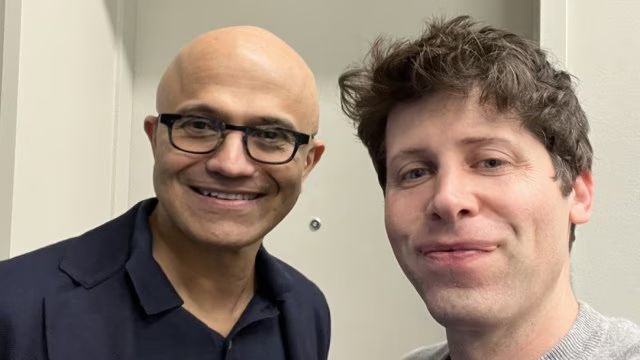
Satya Nadella, Microsoft’s CEO, reportedly emphasized that “responsible progress requires shared governance.” By codifying external oversight, Microsoft positions itself as the ethical leader in corporate AI development, not merely a commercial beneficiary.
Defining AGI — The Elusive Milestone
Artificial General Intelligence is the holy grail of computing — the point where machines can perform any cognitive task a human can, without domain-specific training.
Unlike current AI models trained for narrow tasks, AGI would exhibit:
- Transfer learning: Ability to apply knowledge from one field to another.
- Self-reflection: Understanding and improving its own reasoning processes.
- Common-sense reasoning: Contextual awareness across diverse scenarios.
- Goal autonomy: Setting and pursuing objectives without explicit programming.
Experts warn that the leap from advanced AI to true AGI is not linear. Even as models like GPT-5 demonstrate reasoning, they lack persistent memory, physical embodiment, and moral intuition — all essential elements of general intelligence.
The independent panel’s creation acknowledges this complexity, ensuring that any AGI claim undergoes rigorous scientific scrutiny rather than marketing hype.
Ethical and Global Implications
The move comes amid rising global anxiety about the pace of AI advancement. Policymakers fear that uncontrolled AGI development could amplify inequalities, disrupt economies, and threaten democratic stability.
By implementing an external review system, OpenAI and Microsoft send a message: self-policing in AI is evolving into structured accountability.
Internationally, the development resonates with:
- The EU AI Act, which mandates independent audits for high-risk systems.
- U.S. executive frameworks on AI safety and transparency.
- UN initiatives exploring global standards for autonomous intelligence.
If executed properly, this partnership model could become the blueprint for global AI governance — balancing innovation with collective safety.
Industry Reactions
Early industry responses suggest cautious optimism.
- Investors view the move as stabilizing, reducing reputational risk for both firms.
- Academics praise the precedent of external verification, long advocated by AI-ethics scholars.
- Competitors, however, are watching closely — particularly Google DeepMind, Anthropic, and xAI — as the governance shift could reshape funding dynamics across the field.
Analysts also note that Microsoft’s 27 % stake gives it enough influence to steer strategic collaboration, but not so much control as to trigger antitrust concerns — an equilibrium regulators are likely to appreciate.
What It Means for Developers and Enterprises
For developers using the Azure OpenAI Service, the immediate implications are mostly positive.
- Expect greater transparency about model provenance and safety testing.
- Anticipate stricter documentation for high-risk applications like autonomous decision-making and healthcare AI.
- Long-term, the partnership could unlock more stable licensing terms and clearer ethical guidelines for enterprise deployments.
In short, businesses gain predictability and credibility — crucial as governments begin to regulate AI outputs under emerging “trust frameworks.”
Global Oversight Models Compared
| Region | Oversight Approach | Primary Focus | Example Institution |
|---|---|---|---|
| United States | Public–private collaboration | Innovation & safety | NIST AI Safety Institute |
| European Union | Legal compliance framework | Risk classification & audit | EU AI Act Council |
| United Kingdom | Sector-specific regulators | Context-driven oversight | Digital Regulation Co-operation Forum |
| Asia (Pacific) | Innovation-first with ethics charters | Economic growth & standards | Singapore AI Verify, India NITI Aayog |
OpenAI’s independent panel adds a fifth model — corporate-initiated global review — blending industry agility with public-interest accountability.
The Road Ahead
OpenAI’s restructuring and Microsoft’s recalibrated stake mark the beginning of a governance-driven AI era. The move may slow short-term commercialization but could ultimately accelerate public trust — the most valuable currency in technology today.
In coming years, observers will watch three metrics:
- Transparency: How much of the panel’s findings will be public.
- Diversity: Whether panel members represent global perspectives, not just Western institutions.
- Efficacy: Whether oversight mechanisms can adapt as AI capabilities evolve beyond current benchmarks.
Expert Opinion
Dr. Meera Chaudhary, an AI governance researcher, notes:
“This is the first time a leading AI lab has voluntarily placed its progress under independent scrutiny. It could become a model of responsible capitalism in the age of intelligent machines.”
Her sentiment echoes across policy circles: oversight is no longer optional — it’s the entry ticket to legitimacy in the AGI race.
Conclusion
The revised Microsoft–OpenAI deal is not merely a corporate restructuring; it is a statement of intent about how humanity should approach the next leap in intelligence.
By establishing an independent AGI panel and transitioning into a Public Benefit Corporation, OpenAI affirms that progress and responsibility can coexist. Microsoft, with its 27 % stake, secures influence while signaling that governance, not greed, will define the future of artificial intelligence.
As the world edges closer to AGI, this partnership offers a pragmatic template — innovation under watchful eyes, ambition tempered by ethics, and profit guided by purpose.