


By Anushka Verma | November 4, 2025
Introduction
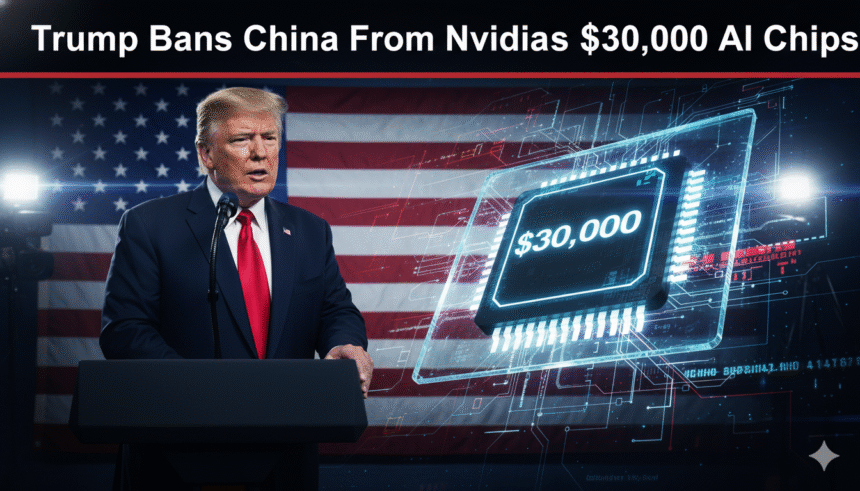
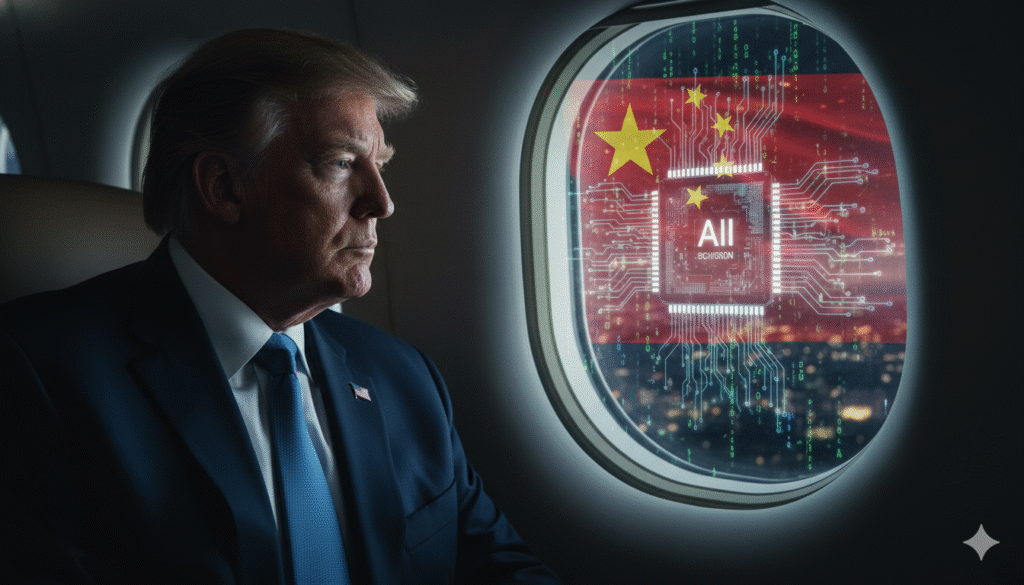
In a bold and controversial move that has sent ripples across global technology and diplomatic circles, U.S. President Donald Trump announced that Nvidia’s most advanced artificial intelligence (AI) chips—known as the Blackwell series, valued at nearly $30,000 each—will be exclusively available to U.S. companies. During an interview broadcast on CBS 60 Minutes and further remarks aboard Air Force One, Trump stated that these top-tier processors would be off-limits to China and several other foreign nations.
The decision marks one of the most consequential steps in the ongoing technological rivalry between the United States and China, intensifying what many analysts now call the “AI Cold War.” Nvidia, the American chip-making giant whose market capitalization recently crossed the $3 trillion mark, stands at the center of this unfolding drama.
Quick Facts Table
| Key Aspect | Details |
|---|---|
| Company | Nvidia Corporation |
| Chip Model | Blackwell GB200 AI Accelerator |
| Approximate Price per Chip | $30,000 (estimated market value) |
| Announcement By | U.S. President Donald Trump |
| Date of Statement | November 3, 2025 |
| Platform | CBS 60 Minutes & Air Force One briefing |
| Policy Impact | Export ban on top-tier AI chips to China and others |
| Market Reaction | Nvidia shares rose 1.8% in pre-market trade |
| Long-Term Goal | Strengthen U.S. AI dominance and domestic production |
The Announcement That Shocked the Tech World
Trump’s declaration was neither subtle nor symbolic. It was a direct message to Beijing, signaling that the United States intends to maintain an unassailable lead in AI infrastructure.
“Only American companies should have access to the most powerful AI technology. We cannot allow adversarial nations to surpass us in artificial intelligence or defense,” Trump said during his interview.
The remarks immediately drew sharp reactions from both Washington insiders and international observers. China’s Foreign Ministry responded within hours, calling the move “a violation of fair-trade principles” and an attempt to “weaponize technology for geopolitical control.”
What Makes Nvidia’s Blackwell Chips So Important?
The Blackwell GB200 represents the pinnacle of modern AI hardware. Each chip integrates tens of billions of transistors and can handle trillion-parameter models that power generative AI systems like ChatGPT and Gemini.
The Blackwell architecture’s ability to process large language models (LLMs), computer vision, and scientific simulations faster than any previous chip has turned it into a strategic asset, not just a commercial product.
Nvidia’s CEO Jensen Huang once described the chip as “a supercomputer in a single package.” That supercomputer, however, will now be strictly confined within U.S. borders—at least for its most advanced versions.
The Political Logic Behind the Ban
Trump’s latest comments build on years of escalating export controls on advanced semiconductors. While previous restrictions under the Biden administration had already limited the sale of A100 and H100 chips to China, the new stance effectively draws a red line around Blackwell.
According to administration sources, the logic is clear:
- Prevent AI militarization by nations seen as strategic competitors.
- Safeguard intellectual property and sensitive algorithms from reverse engineering.
- Boost domestic manufacturing and keep the profits, jobs, and data flows inside the U.S.
Trump also hinted at new federal incentives for chip production, saying the administration plans to invest “hundreds of billions” in U.S.-based semiconductor facilities over the next four years.
Economic Impact: Nvidia at the Center of the Storm
Nvidia’s financial stakes could not be higher. The company’s revenue stream heavily depends on AI data centers and enterprise clients worldwide. In 2024, more than 20% of its sales came from Chinese buyers.
Analysts at Goldman Sachs estimate that cutting China out of the Blackwell line could cost Nvidia $4 billion annually in lost sales. Yet, paradoxically, the short-term market reaction was positive. Investors interpreted Trump’s remarks as a sign that U.S. agencies will pour funding into AI hardware purchases from Nvidia, offsetting losses abroad.
| Economic Indicator | Impact Post-Announcement |
|---|---|
| Nvidia Stock (Pre-Market) | +1.8% |
| U.S. Chip Sector ETF | +1.3% |
| Chinese Tech Index (HK) | -2.5% |
| AI Hardware Futures | Volatile; mixed signals |
Global Reaction: Allies and Adversaries Respond
China’s Outrage
Chinese state media described the move as an “economic attack masquerading as national security.” Semiconductor Manufacturing International Corporation (SMIC) reportedly began consultations with domestic AI firms to accelerate indigenous chip development.
European Concerns
The European Union issued a cautious statement, noting that “open markets and innovation thrive under collaboration, not isolation.” European AI startups fear secondary restrictions if they use Nvidia hardware sourced from the U.S.
Indian Opportunity
India, emerging as a neutral tech hub, could benefit. Several Indian data-center operators and cloud AI startups expect to gain easier access to Nvidia chips as U.S. firms seek trusted partners outside China.
The AI Cold War: Context and Consequences
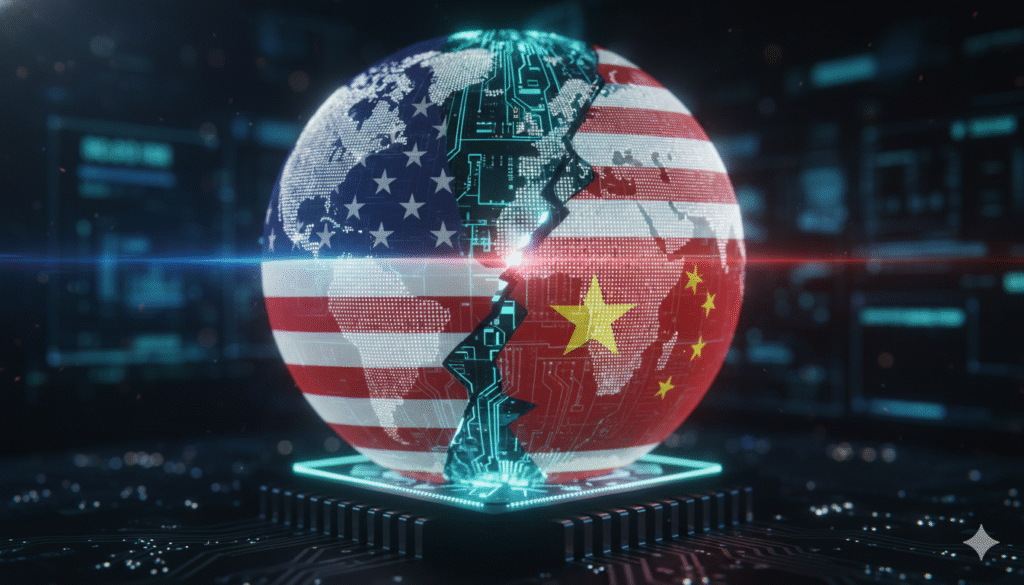
This decision did not occur in isolation. The past five years have witnessed an arms race in AI computing between the U.S. and China.
- In 2022, Washington imposed export controls on advanced GPU sales to China.
- In 2023, Beijing retaliated by restricting exports of gallium and germanium—rare metals vital to chip fabrication.
- By 2024, the conflict expanded into AI software and cloud services.
Trump’s 2025 policy now effectively closes the door on top-tier AI hardware, solidifying a new economic frontier divided by technology sovereignty.
Inside Nvidia: Balancing Profit and Policy
Sources within Nvidia suggest the company had lobbied for a balanced approach, arguing that global sales fund R&D for new chips. However, executives also acknowledge that the U.S. government is now its largest potential client through defense, energy, and education contracts.
CEO Jensen Huang issued a diplomatic statement:
“We respect the U.S. government’s decision and remain committed to supporting America’s AI leadership while serving our customers within regulatory guidelines.”
Behind the scenes, Nvidia has reportedly accelerated plans to expand its U.S. manufacturing capabilities in Texas and Arizona, reducing dependence on Taiwanese supply chains.
Technology Nationalism: The New Oil
Economists increasingly view AI chips as the new oil—the resource powering everything from autonomous weapons to digital governance. By reserving these chips for U.S. entities, Trump has effectively created a digital OPEC, with Washington as the main controller of AI fuel.
While this may strengthen short-term national security, critics warn it could spark a wave of technological protectionism, pushing other nations to create their own closed AI ecosystems.
Impact on AI Research and Innovation
Research institutions worldwide rely on Nvidia hardware to train AI models. The restriction means that Chinese universities and tech firms will be forced to use less efficient alternatives, potentially delaying their research by years.
On the flip side, U.S. universities could experience a boom in AI innovation, as they gain preferential access to Blackwell-class hardware through government-funded programs. Venture capital flows are expected to shift toward Silicon Valley and Austin, where new AI labs are rapidly emerging.
Expert Opinions: Divided Reactions
| Expert | Affiliation | Key Quote |
|---|---|---|
| Dr. Ellen Markowitz | MIT AI Ethics Lab | “Limiting AI chips won’t stop AI development—it will just change who gets there first.” |
| Rajiv Menon | Indian Tech Policy Forum | “This is a strategic opportunity for India to position itself as a trusted AI manufacturing ally.” |
| Li Wei | Peking University | “The ban confirms that AI is no longer just science—it’s geopolitics.” |
| Carla Henderson | Stanford Business School | “Investors should expect short-term volatility but long-term U.S. dominance.” |
The Legal and Ethical Debate
Critics argue that the ban might violate World Trade Organization rules on non-discriminatory access to technology. However, the U.S. can invoke national security exceptions to justify the policy.
Ethically, some analysts fear that creating an AI monopoly within one nation could concentrate too much power in the hands of a few companies and government agencies. AI ethicists warn that innovation without inclusivity could lead to bias and digital inequality on a global scale.
How China Plans to Respond
China is unlikely to remain idle. Insiders in Beijing say the government is preparing a $50 billion fund to accelerate domestic AI chip design under projects led by Huawei and Baidu. While these chips may not match Nvidia’s performance immediately, China has a track record of catching up rapidly in key technologies.
The ban could thus trigger a “Sputnik moment” for Chinese AI, spurring a national drive for self-reliance and technological independence.
Nvidia’s Strategic Shift
To navigate the new environment, Nvidia is reportedly developing “international variants” of its Blackwell chips with slightly lower performance metrics. These models could be exported legally without violating U.S. trade restrictions, ensuring some continued revenue from foreign markets.
Meanwhile, the company plans to channel its massive profits from U.S. defense contracts into research for quantum accelerators and energy-efficient AI processors expected by 2027.
Impact on Global Start-ups and Data Centers
AI start-ups outside the U.S. face an immediate challenge: hardware scarcity. Many data centers in Singapore, London, and Dubai had been relying on Nvidia’s upcoming Blackwell GPUs for model training. Now, those orders are on hold pending government clarification.
Cloud providers like Amazon and Microsoft are also expected to reprioritize chip allocation toward U.S.-based clients. This creates a short-term bottleneck for global AI growth but may lead to diversified innovation as companies seek alternative hardware from AMD or custom ASIC developers.
The Role of India in the New Tech Order
India stands at a strategic crossroads. With its rapidly growing AI ecosystem and trusted relations with both the U.S. and China, it could become a neutral ground for collaborative AI research and manufacturing. Indian officials are reportedly in talks with Nvidia to set up a local assembly unit in Hyderabad or Bangalore.
“India has the talent, the market, and the neutrality to benefit from the AI realignment,” says Dr. Menon of the Indian Tech Policy Forum.
If successful, India could not only gain access to U.S. hardware but also emerge as a bridge for AI collaboration between the East and West.
The Future of AI: Cooperation or Competition?
The next five years will determine whether AI becomes a force for global progress or a dividing line between superpowers. Experts suggest three possible scenarios:
- Fragmented AI World: Separate AI ecosystems for U.S. and China, each with their own hardware and software standards.
- Selective Collaboration: Allies like India and Japan act as mediators, maintaining some exchange of knowledge and resources.
- AI Detente: Eventually, economic interdependence forces a softening of export restrictions.
At the moment, the first scenario appears most likely, as Washington and Beijing dig in for a long-term technological standoff.
Conclusion: The Price of Power
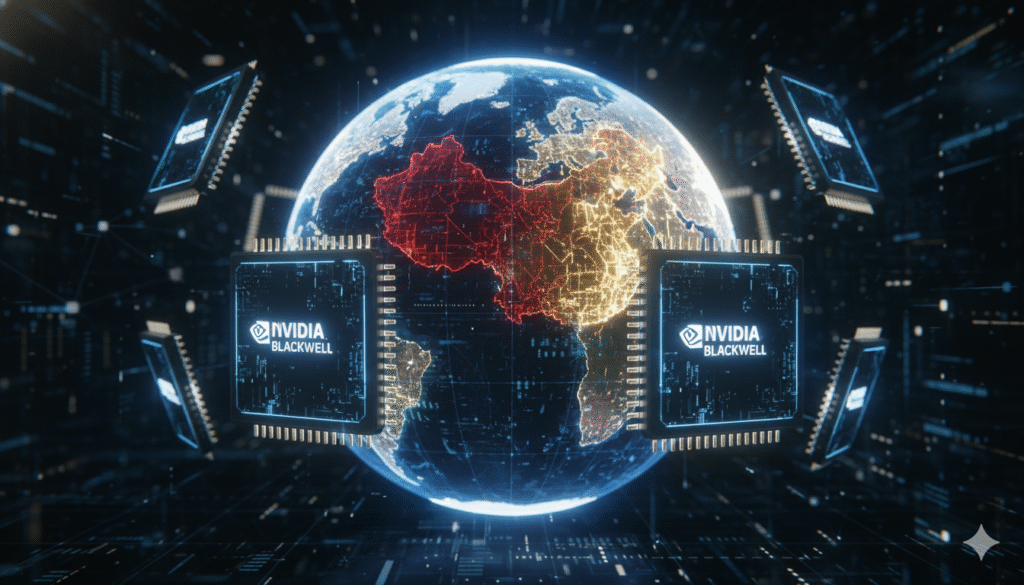
Trump’s ban on the export of Nvidia’s Blackwell AI chips to China marks a historic turning point. It is not merely about silicon or software—it is about who controls the future of intelligence itself.
For the United States, the policy reflects a desire to protect national security and retain technological dominance. For China and other nations, it is a wake-up call to build self-reliant AI industries.
For Nvidia, it means balancing profit with patriotism, and for the rest of the world, it underscores a stark truth: the battle for AI supremacy has just begun—and the price tag is $30,000 a chip.


