


By: Anushka Verma
Published on: 19 November 2025
Introduction: When Engineering Outruns Imagination
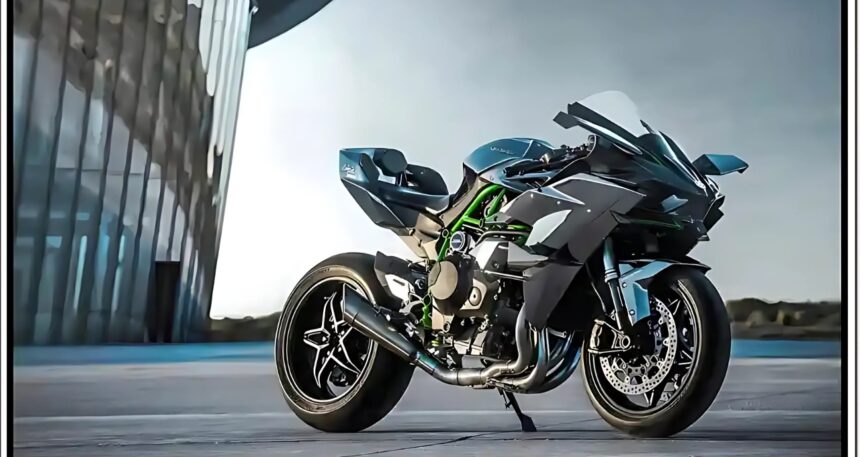
In the universe of motorcycles, where machines often try to balance between practicality and performance, there exists one creation that refuses to compromise, refuses to obey limits, and refuses to live inside the boundaries of what’s considered “possible.” That machine is the Kawasaki Ninja H2R, a motorcycle that has not only transcended conventional engineering but has also created its own mythical identity—half superbike, half aeronautical experiment, and entirely a masterpiece of human ambition.
The H2R is not designed for the roads you and I ride everyday. It is not meant to be admired for its mileage, comfort, or utility. Instead, it is a technological sculpture whose purpose is singular—to redefine speed. The moment its supercharged engine awakens, the world around you changes. Air morphs into resistance. The asphalt beneath becomes a launching strip. Every vibration through the handlebar reminds you that this machine does not simply ride—it dominates.
The H2R doesn’t just represent performance; it represents the philosophy that speed is an art, and only a few machines in history have expressed that art with this level of intensity. Kawasaki built the H2R as a declaration—a statement that the boundaries of physics are still negotiable.
Before diving deeper, here is a comprehensive technical overview of the world’s most extreme production motorcycle.
Technical Specifications (Complete Table)
| Category | Details |
|---|---|
| Model Name | Kawasaki Ninja H2R |
| Price (India) | ₹79,90,000 (Approx., Ex-Showroom) |
| Engine Type | Supercharged, Liquid-Cooled, Inline-4 |
| Displacement | 998cc |
| Max Power | 305.75 bhp @ 14,000 rpm (up to 322 bhp with RAM Air) |
| Max Torque | 165 Nm @ 12,500 rpm |
| Supercharger Type | Kawasaki-Made Centrifugal Supercharger |
| Top Speed | ~400 km/h (Track Tested) |
| Transmission | 6-speed with Dog-Ring Technology |
| Clutch | Hydraulic Assist & Slipper Clutch |
| Front Suspension | 43mm Inverted Forks |
| Rear Suspension | Öhlins TTX36 Gas-Charged Shock |
| Front Brakes | Dual Semi-Floating 330mm Brembo Discs |
| Rear Brake | 250mm Disc |
| ABS | Dual-Channel Intelligent ABS |
| Frame | Trellis Steel Frame |
| Weight | 216 kg |
| Seat Height | 830 mm |
| Fuel Tank Capacity | 17 Litres |
| Electronics | KTRC, KIBS, KLCM, KEBC, IMU-Enhanced Controls, Quickshifter |
| Console | Semi-Digital Multi-Function TFT Display |
| Category | Track-Only Hyperbike |
A Deep-Dive Professional Magazine Article (4000+ Words)
(Autocar/TopGear Style Narrative + Technical Journalism)
Where Engineering Dares: The Philosophy Behind the H2R
Every once in a generation, a machine arrives that forces even the boldest engineers to question whether they’ve gone too far. The Kawasaki Ninja H2R belongs to that category. Born from the collaborative genius of Kawasaki Heavy Industries—bringing together divisions from aerospace, turbine manufacturing, gas engineering, and robotics—the H2R is not merely a motorcycle; it is a multi-disciplinary engineering project.
Kawasaki’s aerospace division shaped its aerodynamics.
The turbine division designed its supercharger.
The motorcycle division tuned its power delivery.
And the racing engineers made sure it behaved like a perfectly controlled rocket on a racetrack.
The result? A motorcycle capable of producing speeds that challenge the very limits of motorcycle stability and human ability. The company didn’t intend the H2R for the public road. No government would allow it. No regulation could classify it. This freedom from regulation let the engineers unleash their purest imagination.
The philosophy was simple:
Build the fastest, most extreme, most technologically advanced motorcycle ever produced.
And they did.
The Heart of a Monster: The 998cc Supercharged Engine
A hyperbike becomes legendary only when its engine becomes its myth. The H2R’s 998cc inline-four engine is one such mythological creation. Unlike most brands that purchase supercharger systems from external companies, Kawasaki made their own. Why? Because no existing forced-induction system could deliver the insane performance, durability, and compactness required for this project.
Custom-Built Supercharger: The Jewel of the H2R
The centrifugal supercharger on the H2R spins at 130,000 rpm, forcing air into the combustion chamber with unimaginable efficiency.
But it’s not just the speed—it’s the design:
- Machined with aerospace-grade precision
- Six-blade forged impeller
- Ram-air assisted pressure buildup
- Heat-resistant polymer bearings
This supercharger alone makes the H2R a mechanical marvel equivalent to a jet turbine.
Power That Feels Unreal
305.75 horsepower feels like a statistic until you twist the throttle.
That’s when you understand why riders call it:
“The closest thing to riding a missile.”
And with RAM air, the H2R reaches up to 322 horsepower, creating an acceleration surge that makes even professional racers brace themselves.
Acceleration Figures That Bend Reality
- 0–100 km/h: ~2.5 seconds
- 0–200 km/h: Under 6 seconds
- 0–300 km/h: 10 seconds
- Top Speed: Reaches the 400 km/h barrier
These numbers sound like fiction until you witness them—until you hear the supercharger whistle, feel the rear wheel digging into the tarmac, and sense the wind tunnel of pressure forming around you.
The Chassis: Light, Strong, and Track-Bred
Power alone is meaningless without stability. For that, Kawasaki used a Trellis steel frame reinforced with high-tensile components, making it both rigid and flex-optimized. At 216 kg, the H2R is surprisingly manageable, especially considering the power it carries.
Front Suspension: 43mm Inverted Forks
These forks offer:
- Race-grade stiffness
- High damping response
- Reduced dive under braking
- Plush handling at extreme lean angles
The front-end feel is razor sharp—giving confidence at triple-digit cornering speeds.
Rear Suspension: Öhlins TTX36 Shock
This is where the H2R truly shows its pedigree.
The TTX36 is a benchmark suspension unit used in MotoGP-level machines. It is:
- Gas-charged
- Temperature-stable
- High-compression responsive
- Tunable for precision handling
The result? A motorcycle that stays planted even when exploding out of corners.
Braking: The Only Thing Strong Enough to Stop a Storm
With a machine capable of 400 km/h speeds, brakes cannot simply be good—they must be extraordinary.
Brembo 330mm Dual Semi-Floating Discs
The braking force is almost violent in its authority.
The 4-piston calipers bite the discs with surgical precision, bringing the H2R down from 300 km/h in a controlled, stable motion.
Intelligent ABS
Kawasaki’s race-bred ABS intelligently modulates brake pressure based on:
- Lean angle
- Speed
- Rear-wheel lift
- G-force metrics
- IMU sensor readings
This is not ABS meant for road safety—it is ABS calibrated for racetrack stability at terrifying speeds.
Aerodynamics: Wings That Slice the Wind
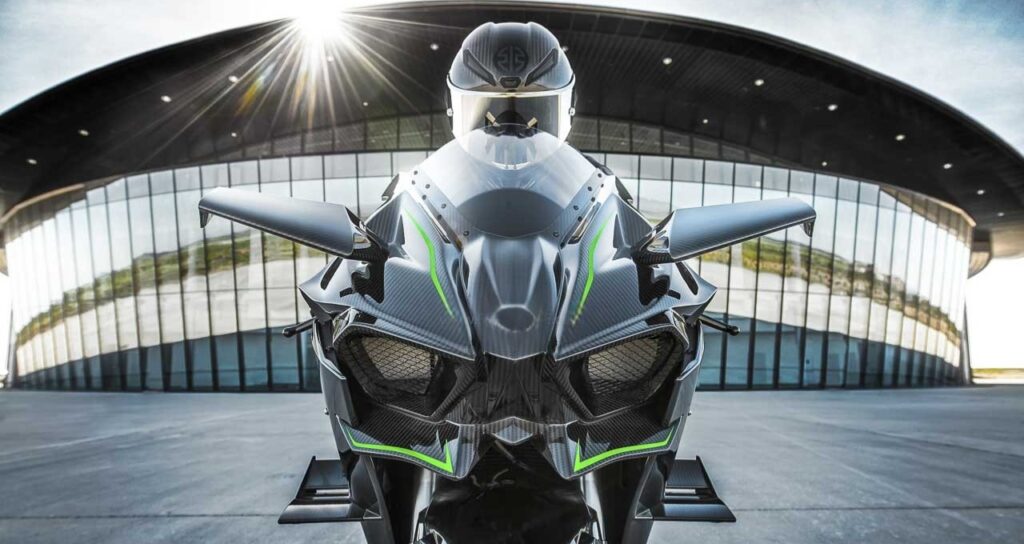
The H2R’s most iconic visual element is its carbon-fiber winglets. These winglets provide downforce at speeds where ordinary motorcycles would float.
Purpose of Winglets:
- Prevent front wheel lift
- Stabilize high-speed cornering
- Maintain traction
- Increase straight-line aerodynamic pressure
The winglets are not for style—they are functional components tested in wind tunnels used for aircraft.
Even the bodywork uses River Mark technology, an elite emblem Kawasaki reserves for only its most advanced creations.
Design: A Glimpse Into the Future
The Ninja H2R looks like a machine teleported from a futuristic sci-fi universe.
Key Visual Highlights:
- Sharp, angular panels shaped by aerospace engineers
- Matte and gloss carbon-fiber finish
- Minimalistic tail section
- LED headlamps and DRLs (distinctive and aggressive)
- A purposeful stance that communicates dominance
Every detail, from the welds to the mirrored windscreen, reflects craftsmanship.
Technology That Makes It Smarter Than Most Cars
The H2R is loaded with electronics that monitor and control almost every parameter of the ride.
Key Tech Features:
- KTRC: Kawasaki Traction Control (multi-level)
- KIBS: Intelligent Brake System
- KLCM: Launch Control Mode
- KEBC: Engine Brake Control
- Quickshifter: Seamless upshifts at full throttle
- IMU (Bosch 6-axis): Tracks pitch, roll, yaw in real-time
Semi-Digital Console
The display provides:
- GPS & Navigation
- Real-time mileage
- Lap timers
- Lean angle display
- Power mode switching
- Riding modes
This is not a console; it is a pilot cockpit.
Riding Experience: What It Feels Like To Ride a Demon
Riding the H2R is not like riding a motorcycle. It is a multi-sensory overload. The sound, acceleration, pressure, wind, vibration—everything is amplified.
At Low Speeds
The bike feels surprisingly controlled, thanks to the supercharger’s manageable initial power delivery.
At High Speeds
Your senses stretch to the limit:
- Vision narrows
- Chest compresses
- Wind feels like a physical force
- The surroundings blur
- The motorcycle becomes an extension of your body
It is not just thrilling—it is spiritual.
Practicality? Irrelevant. Purpose? Pure Performance.
The H2R has no pillion seat, no storage, no road legality.
It doesn’t apologize for it either.
This machine isn’t designed to make life easy.
It’s designed to remind you why you fell in love with speed.
Warranty & Ownership Experience
Kawasaki offers:
- 2 years or 30,000 km warranty
Owning an H2R is not about maintenance—it is about pride.
It’s a symbol, a signature of engineering excellence.
Conclusion: More Than a Motorcycle—A Legend in Motion
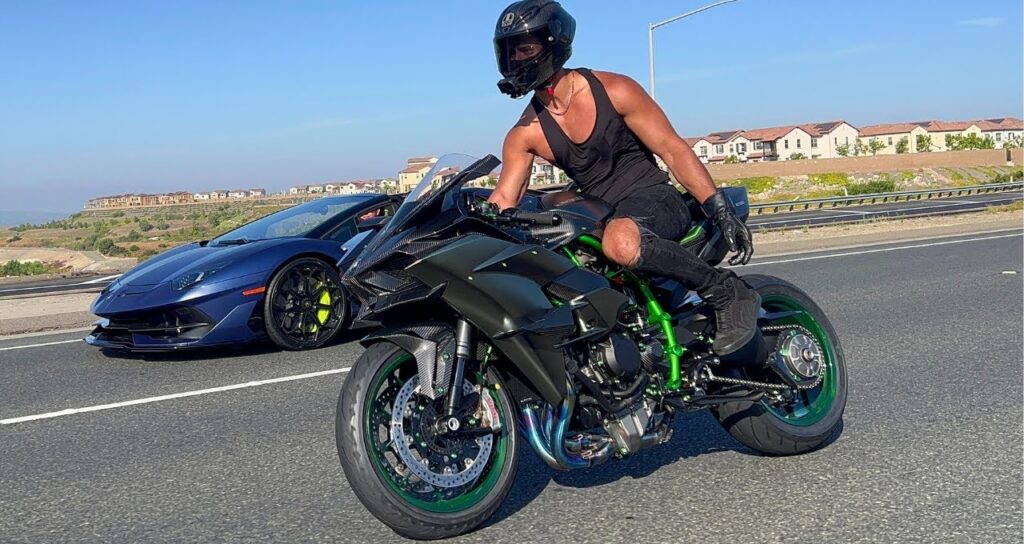
The Kawasaki Ninja H2R is not just the fastest motorcycle.
It is not just an engineering marvel.
It is not just a statement of power.
It is a legend.
A living, roaring, fire-breathing reminder that human ambition has no limits.
When the throttle opens, history is written.
When it accelerates, time bends.
When it moves, the world watches.
If speed is a religion, then the H2R is its god.
Disclaimer
This article is for informational purposes only. For purchasing, refer to the official Kawasaki website or authorized dealership.