


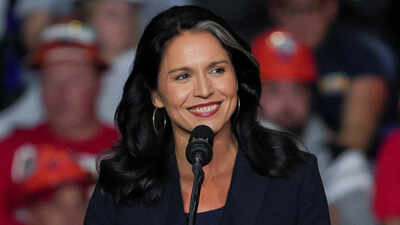
US Director of National Intelligence Tulsi Gabbard has said the US has funded more than 120 biological laboratories in over 30 countries, while also announcing a policy shift under President Donald Trump to end federal support for gain-of-function research worldwide.The disclosures were made on Thursday and were based on newly declassified intelligence material. This disclosure has triggered debate over overseas biological research and US national security oversight.According to a statement from the Office of the Director of National Intelligence (ODNI), many of the facilities have been involved in work on hazardous and highly contagious pathogens under limited oversight.“ODNI will continue to work closely with partners across the government to identify where these labs are, what pathogens they contain, to end dangerous Gain-of-Function research that threatens the health and well-being of the American people and people around the world,” Gabbard stated.Gabbard also said declassified records show that more than 40 laboratories in Ukraine handled Soviet-era biological warfare pathogens and conducted research involving especially dangerous pathogens, including anthrax, Ebola, MERS, SARS and plague. One cited example was the Kherson Diagnostic Laboratory, which reportedly received funding of $1,728,822 while its authorisation to work with specific pathogens was still listed as “in progress.”The ODNI statement added that the intelligence community is expanding its review of overseas facilities and their activities, including clinical trials in order to assess risks linked to foreign-funded research programmes.Gabbard also issued a directive for increased intelligence collection on such facilities, saying it is already uncovering further details about ongoing work and raising significant ethical, financial and security concerns.“Despite the obvious potential for catastrophic global impact research on dangerous pathogens in biolabs can have, politicians, so-called health professionals like Dr Fauci, and entities within the Biden administration’s national security team lied to the American people about the existence of US-funded and supported biolabs, and threatened those who attempted to expose the truth. ODNI will continue to work closely with partners across the government to identify where these labs are, what pathogens they contain to end dangerous Gain-of-Function research that threatens the health and wellbeing of the American people and people around the world,” said DNI Gabbard.Separately, Gabbard has rescinded two Biden-era intelligence assessments on so-called “Havana Syndrome”, also known as anomalous health incidents (AHI), which affected US diplomats and intelligence officers overseas.A memo from ODNI said the earlier assessments “selectively excluded relevant intelligence, suppressed alternative analysis, relied on an ethically flawed medical study and “limited intelligence collection to maintain an analytic line which relied on absence of evidence.”The original assessments had concluded it was very unlikely a foreign adversary was responsible for the incidents, though some officials said a small number of cases could not be fully ruled out. The revised move has been welcomed by some lawmakers. “This is huge news for the AHI victim community, analytic integrity, and for the American people,” Rep. Rick Crawford, Republican of Arkansas and chairman of the House Intelligence Committee, said in a statement. “These flawed, fraudulent, and manufactured Intelligence Community Assessments have caused significant harm to some of our nation’s bravest.”The issue of anomalous health incidents first emerged in 2016 in Havana, Cuba, where US personnel reported symptoms including vertigo and severe headaches, later followed by similar reports in other countries. Intelligence agencies have remained divided over whether the cases were caused by directed energy attacks or other explanations.On Thursday, President Donald Trump also nominated Jay Clayton, the US attorney for the Southern District of New York, to succeed Gabbard as Director of National Intelligence.