


For years, the evolution of flight seemed fairly straightforward. Dinosaurs developed feathers, with some learning to glide, and eventually, birds appeared and mastered the skies. Now, a strange fossil from China is making scientists rethink that neat timeline. The feathered dinosaur Anchiornis huxleyi reportedly had four wings, colourful feathers, and a surprisingly messy moulting pattern that suggests it may not have been capable of proper flight at all.Experts say it hints that some dinosaurs could have evolved flight-related features and later lost the ability entirely. A bit like modern ostriches or penguins. The fossil has even been described as the first real “technicolour” dinosaur discovery because traces of its original feather patterns were preserved in remarkable detail. And honestly, it sounds almost impossible that colour could survive for 160 million years.
A four-winged dinosaur fossil discovered in China that changed how birds learned to fly
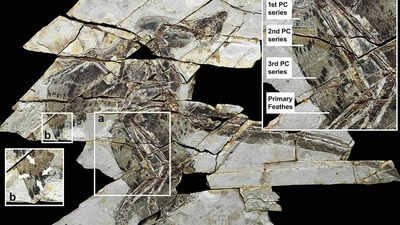
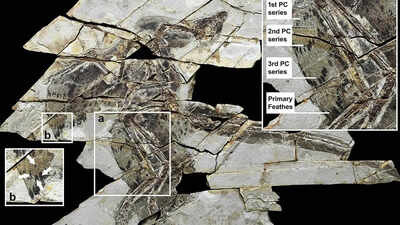
The research focused on nine fossils discovered in eastern China, all belonging to Anchiornis huxleyi, a small feathered dinosaur that lived roughly 160 million years ago. Scientists already knew this species was unusual because it had long feathers not just on its arms, but also on its legs. Which basically gave it four wings.Not four wings in the insect sense, obviously. Still, the structure appears to have helped with gliding or aerial movement in some way. Researchers think these dinosaurs belonged to a larger group called Pennaraptora, which later gave rise to modern birds.Feather fossils are already extremely rare. Feathers decay quickly, so finding preserved ones is unusual enough. Finding fossils that still show colour patterns is on another level entirely. The feathers of Anchiornis huxleyi reportedly appeared mostly white with distinct black tips along the edges of the wings. Scientists say those patterns helped them identify which feathers were old and which were still growing.According to Earth.com, Dr Yosef Kiat from Tel Aviv University explained that feathers grow for a few weeks before becoming dead material. Over time, they wear down and are replaced in a process called moulting.Birds that rely heavily on flight usually moult carefully and symmetrically. They can’t afford to lose too many flight feathers at once, or flying becomes difficult. Flightless birds tend to moult more chaotically because staying airborne is no longer essential.
How these ancient feathers confused researchers
The preserved black spots created a surprisingly clear map of the dinosaur’s wing feathers. Scientists noticed that some newer feathers did not line up properly with the others.That uneven growth pattern seems to suggest the dinosaur was moulting randomly rather than in a controlled sequence. According to the researchers, the moulting pattern strongly points toward Anchiornis huxleyi being largely flightless, despite having wing-like structures and elaborate feathers.For decades, feathers and wings were often treated as signs of steady progress toward modern birds. This fossil hints that evolution may have been much messier. Some dinosaurs might have experimented with flight, partially succeeded, then lost the ability later when environments changed.
The rare fossil that exposed a hidden side of evolution
The discovery could reshape how scientists think about the origin of bird flight. Experts suggest there may have been several separate attempts at evolving flight among feathered dinosaurs. Some lineages survived and improved. Others possibly stalled or went backwards.Modern birds offer similar examples today. Ostriches, emus, and penguins all descended from flying ancestors but no longer fly themselves. Penguins even turned their wings into underwater tools instead.Still, seeing evidence of it in fossils this old is rare. Especially through preserved feather colouration rather than bones alone. Dr Kiat reportedly noted that the feather colours allowed scientists to identify behaviour and functionality, not just physical appearance. In other words, the fossil revealed how the animal may have lived, not simply what it looked like.