

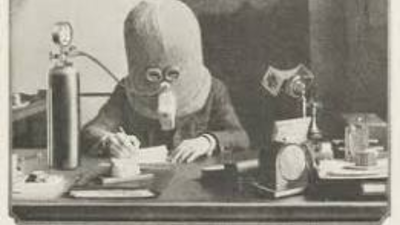
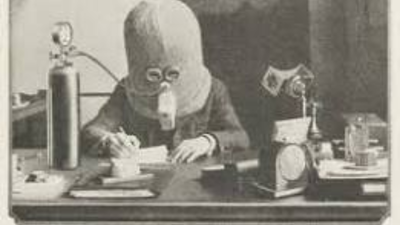
The strange invention called “The Isolator” was conceived by Hugo Gernsback, a prolific inventor and science-fiction writer, in 1925. More than seven decades ago, before anyone talked about noise-cancellation, productivity tools, and deep work techniques, the inventor felt that humans require complete seclusion from everything else to concentrate and be productive. To achieve such an effect, the inventor created a helmet that blocks all outside sounds and visuals, providing air via a breathing tube. The strange-looking isolator helmet is an intriguing reflection of the fears and concerns of people of the early twentieth century. Today, nearly one hundred years later, the invention continues to amaze historians, psychologists, and technology lovers around the globe.
Who was Hugo Gernsback and why did he create the isolator helmet
Gernsback was a successful publishing mogul, an inventor and also an influential editor of science fiction magazines who earned himself the title of the “Father of Science Fiction”. Hugo Gernsback started his career by creating science fiction magazines like Amazing Stories well ahead of time.In accordance with what is reported by the University of Minnesota, Gernsback viewed distraction as a factor reducing intellectual productivity. The man envisioned a future in which the power of scientific thoughts would be increased using mechanical means. According to the article, the mask was supposed to prevent “95 per cent of sound”, and also reduce the field of vision of its wearer.It was first presented in the magazine called “Science and Invention” in 1925. Gernsback said: “The worker puts on the helmet and is then able to concentrate upon his work.”
How the concept of the isolator helmet works even today
It bore more resemblance to a deep-sea diving helmet than office equipment. It completely covered the head and had small eye openings to limit distractions. The oxygen was provided through a breathing tube since the confined nature of the helmet limited airflow.As per the original 1925 description in Science and Invention, the helmet had several layers of sound insulation material that helped cut out any external noise. Gernsback argued that workers, students, and inventors would be able to do their work efficiently without any disturbance. Though the invention failed to make any impact commercially, photographs of the helmet continue to circulate on the internet due to its bizarre look. People have now begun to equate it with VR headsets, noise-cancelling headphones, or gadgets to minimise digital distractions.
The isolator helmet and the modern obsession with productivity
The Isolator seems ridiculous today, but the concept behind it appears quite contemporary. Contemporary workspaces are saturated with conversations around focus, multitasking, exhaustion, and short attention spans. Open-plan offices, incessant alerts, and social media distractions have given rise to many of the same anxieties that Gernsback expressed a hundred years ago.In fact, the American Psychological Association has pointed out how interruptions and multitasking can impact productivity and cognitive functioning. Today, tech companies advertise focus pods, mindfulness apps, and noise-cancelling headphones for the same reasons that The Isolator was invented in 1925. For this reason, the helmet is not simply an oddity from the past. Instead, it serves as a reminder that each generation faces the same problem: how to maintain focus in a distracting environment.
Why the isolator still captures public imagination
One of the things that made the invention appealing is its strangeness; it stands out. Though it was dramatic and even dystopian-looking, the invention actually answered an important question about the problem of human concentration in the world of gradual information overload.The history of technology shows that sometimes an invention could fail in a marketplace but make its mark culturally by contributing to discussions regarding technology and its impact on society. Close to one hundred years after Hugo Gernsback introduced his concentration machine, the underlying concept behind it is still recognisable. Whether in the form of headphones, quiet rooms, or even digital detoxes, people have continued to look for ways to tune out the noise around them.