



By Anushka Verma Updated: November 2, 2025
Introduction: A Historic Day Dampened by Rain
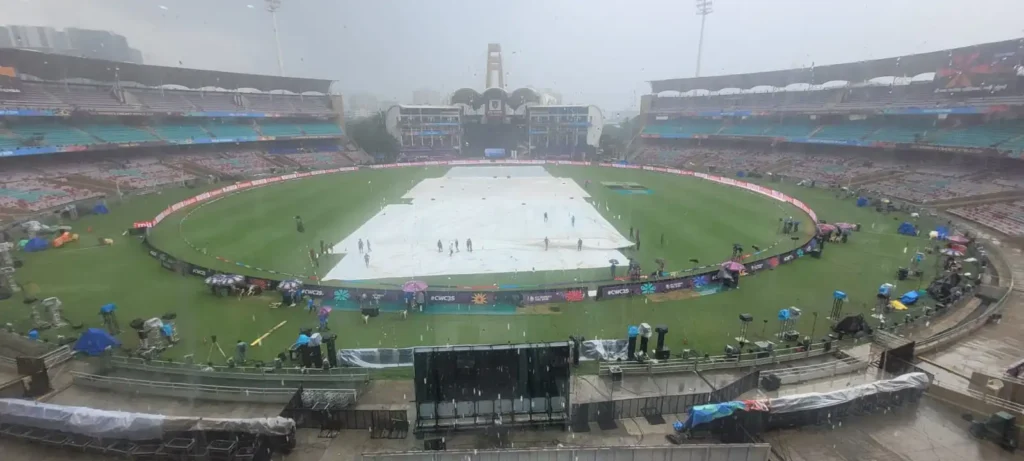
NAVI MUMBAI — The grand finale of the ICC Women’s World Cup 2025 between India and South Africa at the DY Patil Stadium was set to begin amid soaring anticipation, electric excitement, and a palpable sense of history in the making. However, nature had other plans. Just as fans across the country settled in for the toss, heavy rainfall struck Navi Mumbai, delaying proceedings and dampening — quite literally — the mood at the stadium.
The downpour, which began roughly an hour before the scheduled toss at 1:30 PM IST, forced ground staff to rush out with covers and super soppers. What was expected to be a landmark occasion for women’s cricket — marking the rise of a new world champion — has momentarily turned into a waiting game, both for the players and millions of fans watching across the globe.
Despite the interruption, the enthusiasm remains undeterred. The DY Patil stands, painted blue and green, are brimming with expectant supporters waving flags and singing chants. The final between Harmanpreet Kaur’s India and Laura Wolvaardt’s South Africa is more than just a contest for a trophy — it’s a reflection of how far women’s cricket has come and where it is headed.
The Stakes: A New World Champion Awaits
The 2025 Women’s World Cup final carries immense significance for both teams. Neither India nor South Africa has ever lifted the 50-over World Cup before. This ensures that, regardless of the outcome, cricket will celebrate a new world champion tonight — one that will redefine narratives and inspire generations to come.
For India, it’s a moment of destiny. Having lost the finals in 2005 and 2017, and suffered heartbreaks in crucial knockouts since, the Women in Blue stand at the threshold of sporting immortality. Their run to the final has been marked by resilience, belief, and a blend of youthful energy and seasoned leadership.
Meanwhile, South Africa has reached uncharted territory — their first-ever appearance in a 50-over World Cup final, men’s or women’s. Captain Laura Wolvaardt, whose calm presence and record-breaking semifinal century against England powered them here, has already made history. A win would rewrite the trajectory of women’s cricket in the Rainbow Nation.
Road to the Final: Two Different Journeys, One Dream
India’s Grit and Glory
India’s campaign has been nothing short of a rollercoaster. After a mixed start to the tournament and three consecutive losses, questions were raised about their temperament and tactical discipline. Yet, the squad bounced back magnificently, clinching crucial victories over New Zealand and Australia to book their spot in the final.
The semifinal against Australia will forever be etched in Indian cricket folklore. Jemimah Rodrigues’ stunning 127 off 134 balls guided India to a record chase, toppling the mighty Aussies and propelling the team into their third-ever World Cup final. With every elegant drive and resolute stance, Jemimah reaffirmed her status as one of the brightest stars in the modern game.
Skipper Harmanpreet Kaur — often the emotional heartbeat of Indian cricket — has led from the front with poise and determination. Her strategic decisions, particularly in rotating bowlers and promoting young talent like Amanjot Kaur and Kranti Gaud, have earned widespread praise.
South Africa’s Surge of Dominance
In contrast, South Africa’s path to the final has been one of consistency and command. They dominated England in the semifinal, courtesy of Laura Wolvaardt’s magnificent 169 off 143 balls, backed by Marizanne Kapp’s all-round brilliance. The Proteas have showcased a well-balanced unit, with depth in both batting and bowling departments.
The introduction of central contracts in South African women’s cricket just a few years ago is already bearing fruit. This final, as Wolvaardt herself stated, is not merely about winning a title — it’s about changing perceptions back home and providing visibility to a new generation of female athletes.

The Rain Delay: A Pause, Not a Halt
As the rain lashes Navi Mumbai, the groundsmen at DY Patil are working tirelessly. The square and outfield have been covered fully, but the intensity of the downpour suggests a delayed start. Umpires and match officials have yet to confirm a revised toss time.
For players, such delays bring mental challenges. Maintaining focus and composure before a high-pressure game can be tricky. Dressing rooms often turn into spaces of quiet reflection, strategy adjustments, and nervous laughter.
If the match is shortened due to rain, the playing conditions will be revised according to the Duckworth-Lewis-Stern (DLS) method, which could heavily influence team strategies — especially during batting order and bowling rotation decisions.
Team News and Probable XIs
India Predicted XI
Smriti Mandhana, Shafali Verma, Jemimah Rodrigues, Harmanpreet Kaur (c), Deepti Sharma, Richa Ghosh (wk), Amanjot Kaur, Radha Yadav, Kranti Gaud, Sree Charani, Renuka Thakur.
South Africa Predicted XI
Laura Wolvaardt (c), Tazmin Brits, Sune Luus, Anneke Bosch, Marizanne Kapp, Chloe Tryon, Annerie Dercksen, Nadine de Klerk, Sinalo Jafta (wk), Ayabonga Khaka, Nonkululeko Mlaba.
Both sides are expected to stick with their winning combinations from the semifinals. India’s bowling attack, led by Renuka Thakur, has been clinical in the powerplay, while Deepti Sharma’s control in the middle overs remains vital. For South Africa, the trio of Khaka, Kapp, and Mlaba has formed a formidable bowling core capable of exploiting even the slightest moisture on the pitch.
Pitch and Conditions: Red Soil and Rain Clouds
The DY Patil surface, known for its red soil base, generally offers true bounce and rewards stroke-making. However, the heavy showers have dampened the outfield, and the ground staff’s ability to dry the pitch swiftly will be crucial.
The pitch was previously used for the India vs New Zealand encounter earlier in the tournament — a game where India posted a commanding 340. However, under overcast conditions, early movement could favor seamers, particularly Khaka and Renuka Thakur.

Historical Context: Third Time Lucky for India?
This is India’s third appearance in a Women’s World Cup final, having finished runners-up in 2005 (against Australia) and 2017 (against England). Both previous attempts ended in heartbreak, despite stellar performances from Indian legends such as Mithali Raj and Harmanpreet Kaur.
A win today would not only exorcise old ghosts but also symbolize the transformation of Indian women’s cricket from an under-supported side to a powerhouse capable of global dominance. It could also mirror the impact of the Indian men’s World Cup victories in 1983 and 2011 — both of which inspired generations and expanded the sport’s reach across the nation.
Voices from the Camp
Speaking ahead of the final, captain Harmanpreet Kaur emphasized the need for calmness and composure.
“We’ve played this entire tournament with belief. The semifinal win gave us momentum, but the job is not done. We want to create history — not just for ourselves but for every young girl who dreams of playing for India.”
Her counterpart, Laura Wolvaardt, shared similar sentiments:
“This final is about visibility, growth, and pride. For years, our women cricketers have fought for recognition. Winning here would mean a lot to South Africa as a sporting nation.”
The Emotional Undercurrent: Moga to Mumbai
From the dusty lanes of Moga in Punjab to the grand stands of Navi Mumbai, Harmanpreet Kaur’s journey embodies perseverance. Her historic 171* against Australia in the 2017 World Cup semifinal remains iconic — a moment when women’s cricket captured the nation’s imagination. Today, as she leads India once again on the grandest stage, the small town of Moga watches with pride, faith, and tears of hope.
Similar stories run through the squad — Smriti Mandhana, the face of grace under pressure; Richa Ghosh, the fearless wicketkeeper-batter redefining aggression; and Jemimah Rodrigues, whose artistry has brought balance and flair to India’s middle order.
Fans’ Fervor and the National Pulse
Across India, screens are tuned in — from cafes in Bengaluru to school halls in Ranchi. The excitement has transcended gender, age, and geography. Cricket fans, both seasoned and new, have embraced this final as a shared national celebration.
Ticket sales at DY Patil Stadium sold out within hours of the semifinal win. More than 40,000 fans have filled the venue, creating an electric blue wave of support. Outside, thousands more have gathered under umbrellas, chanting slogans and singing patriotic songs, hoping the skies clear soon.
Expert Analysis: What Could Decide the Final
- Opening Partnerships:
Both teams rely heavily on their top-order starts. Mandhana and Shafali for India, Wolvaardt and Brits for South Africa — whichever pair dominates early overs could dictate momentum. - Middle-Over Strategy:
Deepti Sharma’s control against Kapp and Tryon will be key. India’s spinners must counter South Africa’s power hitters who enjoy lofting through midwicket. - Death Overs:
With potential rain-curtailed scenarios, finishing ability will be decisive. Expect Richa Ghosh and Tryon to feature prominently in crunch moments. - Fielding and Pressure Moments:
Finals are often decided not by centuries, but by moments — a sharp catch, a run-out, a misfield. Composure under lights may be the real differentiator.
A Broader Impact: Beyond the Trophy
A victory for India could catalyze unprecedented growth in women’s cricket domestically. The BCCI Women’s Premier League (WPL) has already provided a professional ecosystem for players. A World Cup triumph could open sponsorships, broadcasting deals, and infrastructure investments across states.
For South Africa, a win would vindicate years of effort put into reforming their women’s cricket system. As Wolvaardt noted, “It’s about little girls seeing themselves on television and knowing it’s possible.”
This final isn’t merely about two nations — it’s a global statement about the changing face of women’s sport.
Current Status (2:00 PM IST): Rain Persists
As of the latest update from the venue, rain continues to fall steadily over DY Patil Stadium. The toss remains delayed, with ground staff monitoring radar images closely. The match officials have assured that every effort will be made to ensure a full contest if the weather allows.
Fans, however, remain upbeat — breaking into cheers every time the rain momentarily slows. It’s a scene reminiscent of 2011’s Wankhede energy, where faith triumphed over uncertainty.

Conclusion: Hope Under the Clouds
Whether the rain delays proceedings or not, one thing is certain — this final will mark a turning point in the story of women’s cricket. The journeys of both India and South Africa to this stage have redefined resilience, teamwork, and belief.
For India, victory would be redemption. For South Africa, revolution. And for cricket, evolution.
As umbrellas bloom across Navi Mumbai and chants echo through the drenched stands, the world waits — not just for the rain to stop, but for history to begin.