


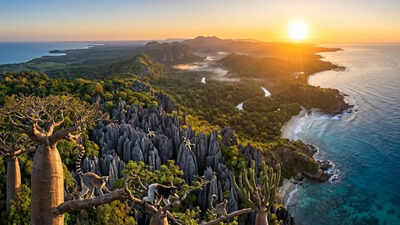
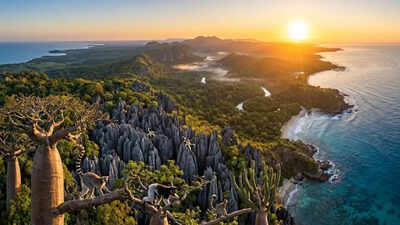
The biological narrative of Madagascar is a 180-million-year history of isolation and evolutionary divergence. Once a part of the Gondwana supercontinent, it broke away from Africa and later split from the Indian subcontinent around 88 million years ago. This separation turned it into a secluded natural lab. With no competition from mainland species, Madagascar’s plants and animals evolved in remarkable ways. Today, more than 90 per cent of its species exist nowhere else on Earth. The island stands out as a global hotspot for biodiversity, featuring everything from ancient primates to specialised plants. It offers a fascinating view into Earth’s deep evolutionary past and highlights how geological changes can drastically affect life.
Madagascar Island became a hidden world of unique creatures
According to the Critical Ecosystem Partnership Fund, Madagascar’s rich biodiversity stems from millions of years of evolution right on the island. After it finally broke away from the Indian plate in the Late Cretaceous period, the ancestors of today’s inhabitants made their way there through rare ‘rafting’ events across the Mozambique Channel. Once they reached Madagascar, these early settlers found themselves free from the evolutionary pressures of Africa’s mainland. This isolation allowed them to fill vacant ecological roles and evolve into unique species such as lemurs and fossas.
How Madagascar’s ancient separation fueled its biodiversity
The staggering uniqueness of Madagascar’s wildlife stands out due to the breakup of Gondwana. Scientists have found that the island first split from Africa around 180–165 million years ago, as noted in Discover Wildlife. Later, it completed its separation from India about 88 million years ago. Because of this two-step isolation, many modern animals never reached Madagascar, so older species had the chance to survive and evolve without competition.
Why most of Madagascar’s wildlife exists nowhere else
It’s like a ‘living museum’ due to its long-term isolation. Scientific studies have found that every native amphibian on the island is unique to it. Likewise, 92 per cent of its mammals, including 108 lemur species, are only found there. When it comes to reptiles, 95 per cent are exclusive to Madagascar as well. Such an extraordinary level of endemism makes the island invaluable for biological research and conservation efforts around the world.